

Artificial intelligence went from “emerging technology” to global utility in under four years. ChatGPT alone is now approaching 1 billion people every week — more users than the entire adult population of Europe and North America combined.
The AI adoption sprinted ahead of anything in tech history. The money chased it, while the returns mostly didn’t show up. At the same time, the labor market started paying the bill anyway.
So, this article covers 75 of the most important AI facts and statistics for 2026 and beyond, drawn from reputable sources like Stanford HAI, the World Economic Forum, McKinsey, Goldman Sachs, PwC, Pew Research, Gallup, and the Bureau of Labor Statistics.
AI Statistics Highlights
- Nearly 1 billion people use ChatGPT every week as of mid-2026, and Google’s Gemini app passed 1 billion monthly users in August — the fastest-growing product in Google’s history.
- 53% of the global population adopted generative AI within three years, a faster uptake curve than either the PC or the internet.
- Nearly 9 in 10 organizations now use AI in at least one business function, but only 6% qualify as AI “high performers” capturing meaningful profit from it.
- $581.7 billion flowed into global corporate AI investment in 2025 — a 130% year-over-year jump.
- 92 million jobs are projected to be displaced globally by 2030, while 170 million new roles are created — a net gain of 78 million.
- AI-skilled workers command an average 62% wage premium over peers in the same role without AI skills, up from 56% a year earlier.
- 116,175 U.S. job cuts were attributed to AI in the first eight months of 2026 — already more than double the total for all of 2025.
- 52% of Americans are now more concerned than excited about AI in daily life, up from 37% in 2021 — and for the first time, a majority of adults under 30 agree.
AI Adoption Statistics: The Fastest-Adopted Technology in History
- 53% of the global population adopted generative AI within three years — faster than the PC or the internet. (Stanford AI Index 2026)
- ChatGPT is approaching 1 billion weekly users, roughly one in nine people on Earth. (OpenAI, July 2026)
- 52% of U.S. employees now use AI at work, up from 21% in 2023. (Gallup)
Every technology story starts with who’s using the thing, but this one starts with almost everyone.
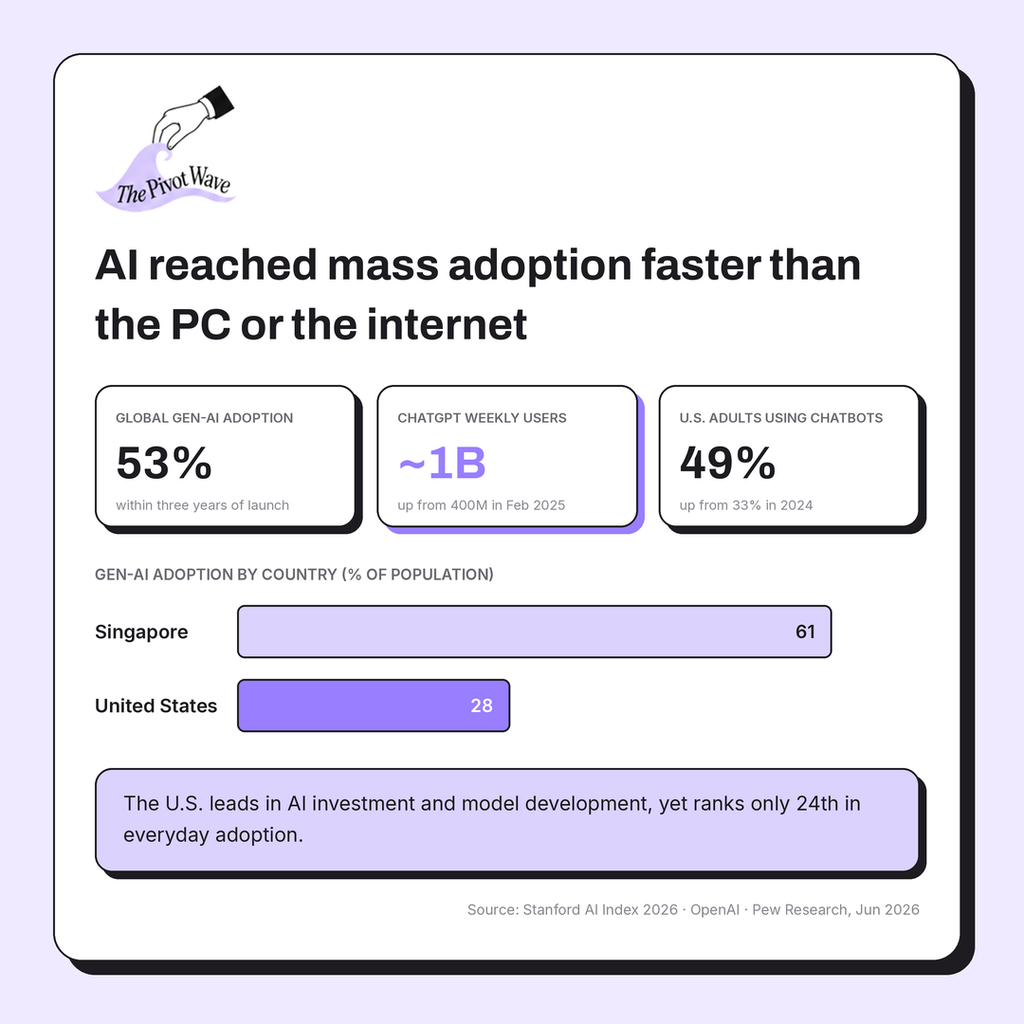
Generative AI reached 53% population adoption within three years of ChatGPT’s public launch, outpacing the adoption curves of the personal computer and the internet, according to Stanford’s 2026 AI Index. It is, by measurable standards, the fastest-adopted consumer technology in modern history.
ChatGPT hit 900 million weekly active users in February 2026, according to OpenAI — up from 400 million in February 2025 and 700 million in July 2025. By late July 2026, OpenAI said the product was approaching 1 billion weekly users, having already crossed 1 billion monthly users in May. The product reached 100 million users in just five days after launch; TikTok took nine months to do the same.
Roughly one in nine people on Earth now uses ChatGPT in a given week. The tool was processing approximately 2.5 billion prompts per day — around 18 billion messages per week — as of mid-2025, the last time OpenAI disclosed the figure. With weekly users up by nearly half since then, current volume is almost certainly higher.
The user base changed as it grew. At launch in late 2022, roughly 80% of ChatGPT users were male; by early 2026, about 52% are women. And the map doesn’t look the way you’d guess: Singapore leads the world in generative AI adoption at 61%, followed by the United Arab Emirates at 54% — while the United States, despite leading in AI investment and model development, ranks 24th at 28.3% in Stanford’s cross-country comparison.
Inside the U.S., the curve is still steep. 49% of adults now use AI chatbots, up from 33% in 2024, according to Pew Research. 44% use ChatGPT (up from 18% in 2023), and about one in four use a chatbot every day. At work, 52% of U.S. employees use AI, Gallup found in mid-2026 — up from 21% in 2023 — with 15% using it daily.
What are a billion people actually doing in there? When OpenAI analyzed 1.5 million real conversations, it found that 49% of usage was “Asking” — seeking information, recommendations, or advice — while 40% was “Doing” (writing, coding, producing output) and 11% was “Expressing.” At work, the balance flips: users are twice as likely to be “doing.” By topic, practical guidance leads at about 29% of messages, followed by seeking information (24%), writing (24%), multimedia (7%), and technical help (5%). Coding is a far smaller share of consumer usage than most people assume.
A billion weekly users is the setup. What happened next is what always happens when adoption moves that fast: the money arrived.
AI Investment Statistics: $581.7 Billion In, and a Market-Share War
- Global corporate AI investment hit $581.7 billion in 2025, up 130% year over year. (Stanford AI Index 2026)
- Anthropic’s revenue run rate reached $65 billion by late July 2026 — the fastest ramp in software history — with OpenAI’s topping $40 billion. (Bloomberg / TechCrunch)
- ChatGPT’s share of generative AI traffic fell from 76% to 53.9% in a year as Gemini surged to 27.9%. (Similarweb)
Global corporate AI investment hit $581.7 billion in 2025, up 130% from the prior year, according to Stanford’s 2026 AI Index. Private investment alone reached $344.7 billion — a 127.5% increase over 2024 — and generative AI companies took $170.9 billion of it, roughly half. Since 2013, corporate AI investment has increased 40-fold.
The geography of the money is lopsided. U.S. private AI investment reached $285.9 billion in 2025 — roughly 23 times China’s $12.4 billion and nearly 50 times the UK’s $5.9 billion. The U.S. also led in AI entrepreneurship with 1,953 newly funded AI companies in 2025 out of 3,499 globally — more than ten times the next-highest country.
The revenue curves have no precedent in software. OpenAI’s annualized revenue run rate topped $40 billion in August 2026, double the roughly $20 billion it reported at the end of 2025 — on the back of more than 50 million paying consumer subscribers and 9 million paying business users. Anthropic’s run rate surpassed $65 billion by the end of July, up from $9 billion at the end of 2025 — the fastest revenue ramp in software history. OpenAI raised a $110 billion private funding round in early 2026, one of the largest private rounds on record.
And the competition turned into a genuine race. ChatGPT’s share of generative AI web traffic fell from about 76% in mid-2025 to 53.9% in May 2026, according to Similarweb, while Gemini surged from under 9% to 27.9% — Google’s Gemini app passed 1 billion monthly users in August, the fastest-growing product in the company’s history. Claude holds 9.2% of traffic, DeepSeek 4.1%, Grok 2.4%. The pie is growing even as it’s carved up: total traffic to generative AI tools rose 70% year over year to 9.5 billion monthly visits, and ChatGPT now ranks as the #10 most-visited domain globally — ahead of Amazon, Instagram, and YouTube.
The infrastructure spending matches the ambition. Google reported more than $150 billion in annual capital expenditures in 2025, most of it tied to AI. Hyperscalers together are spending roughly $667 billion. The forecasts justify it on paper: McKinsey puts generative AI’s potential at $2.6 to $4.4 trillion in annual value, Goldman Sachs projects it could raise global GDP by 7% over a decade, and the IMF raised its 2026 global growth forecast to 3.3% explicitly citing the AI investment boom. China, meanwhile, is placing its bet in atoms as much as bits — it accounted for 54% of global industrial robot installations in 2025 — while U.S. organizations released 50 “notable” AI models and GitHub now hosts 5.58 million AI-related projects, five times the 2020 count.
Half a trillion dollars a year, chasing trillion-dollar projections. Which raises the obvious question: where are the returns?
AI ROI Statistics: 90% of Companies Use AI, Only 6% Profit From It
- Nearly 9 in 10 organizations use AI, but only 6% qualify as “high performers” attributing meaningful profit to it. (McKinsey State of AI 2026)
- 56% of CEOs say AI has delivered no significant financial benefit yet. (PwC Global CEO Survey 2026)
- Workers save 40–60 minutes per day with AI — yet Goldman finds no meaningful AI-productivity relationship at the economy-wide level. (OpenAI / Goldman Sachs)
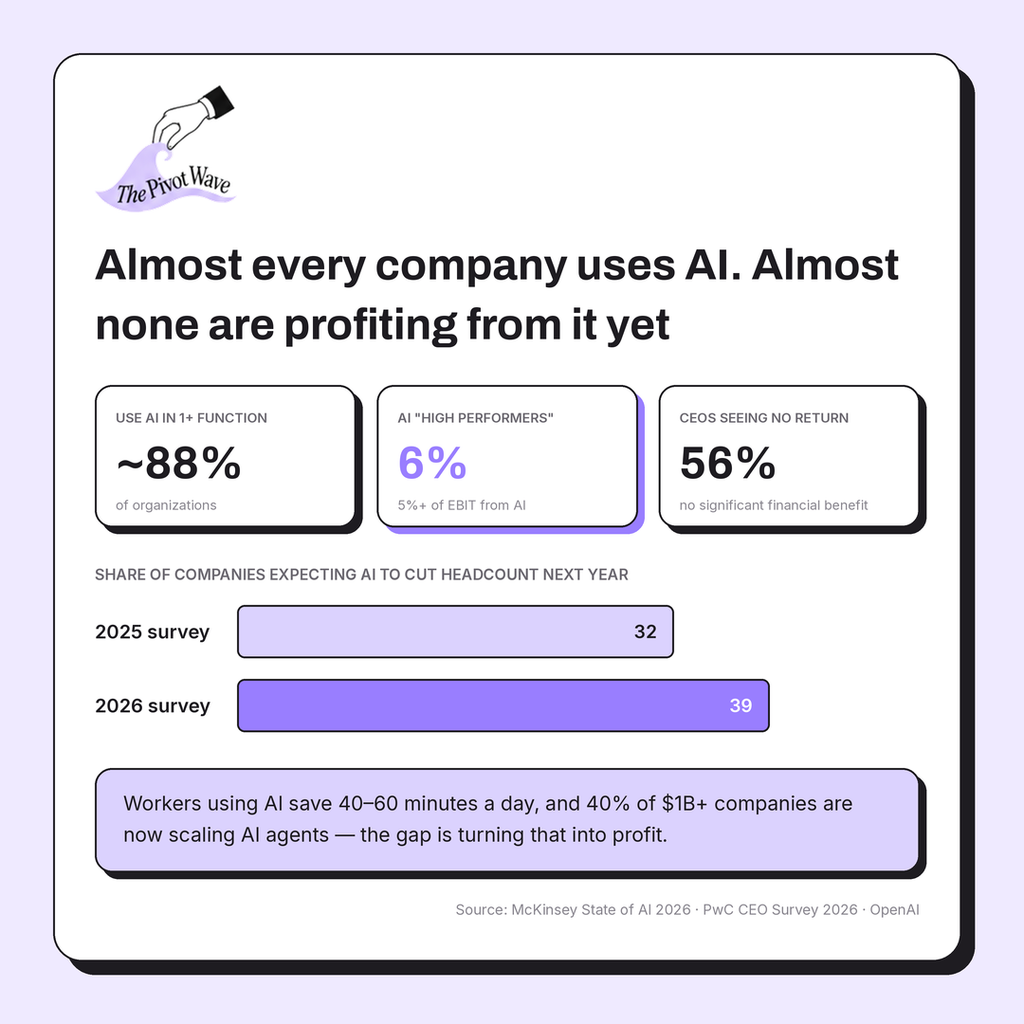
Nearly nine in ten organizations now report regular use of AI in at least one business function, according to McKinsey’s State of AI 2026 survey of 1,719 companies across 97 countries. 56% use it in three or more functions, and 44% are scaling AI across the enterprise, up from 38% a year earlier.
But adoption is not payoff. Only about 6% of organizations qualify as AI “high performers” — attributing at least 5% of EBIT to AI — a share unchanged from 2025. Just 37% report any measurable EBIT impact at all. The CEOs are blunt about it: 56% say AI has delivered no significant financial benefit yet, and only 12% report both cost savings and revenue gains, per PwC’s survey of 4,454 chief executives.
The strange part is that the gains are real — at the level of the individual worker. People using AI save an average of 40 to 60 minutes per day on professional tasks, according to OpenAI’s study of roughly 9,000 employees, with the heaviest users saving more than 10 hours per week. In McKinsey’s survey, 80% of respondents say AI has improved their individual productivity. Controlled studies back it up: 14–15% gains in customer support, 26% in software development, up to 50% in marketing output. Goldman Sachs finds a median gain of about 30% in the functions where AI is deployed well.
And yet the same Goldman research finds “no meaningful relationship” between AI adoption and productivity at the economy-wide level — AI is adding only an estimated 0.1 to 0.2 percentage points to GDP growth in 2026, against that $667 billion in infrastructure spending. Minutes saved per worker are not turning into margin, and margin is not turning into GDP. At least not yet.
Companies are responding by going deeper rather than broader. 40% of companies with $1 billion or more in revenue are now scaling AI agents, up from 27% last year; Microsoft reports active agents in Microsoft 365 grew 15-fold year over year; OpenAI’s Codex coding tool reached 1.6 million weekly active users, tripling since January. The friction shows in the details, though: 81% of marketers use ChatGPT and 73% use AI daily, but only 26% of knowledge workers see clear leadership alignment on AI at their company — and 4.7% of enterprise users have pasted sensitive data into ChatGPT along the way.
So the returns are stuck somewhere between the worker and the balance sheet. But companies didn’t wait for the productivity data to settle before acting on the cost side. That’s where the labor market comes in.
AI Job Displacement Statistics: Layoffs, Lost Rungs, and Who Pays
- 116,175 U.S. job cuts were attributed to AI in the first eight months of 2026 — more than double all of 2025. (Challenger, Gray & Christmas)
- Employment of 22–25-year-olds in the most AI-exposed occupations is 19% below trend, up from a 13% gap a year earlier. (Stanford, August 2026)
- 92 million jobs displaced vs. 170 million created by 2030 — a net gain that masks a brutal transition. (WEF)
The macro forecast still reads as a net positive. The World Economic Forum projects that 92 million jobs will be displaced and 170 million new roles created by 2030 — a net gain of 78 million jobs globally, with 22% of today’s jobs disrupted along the way. We unpack that split in detail in our AI and job market data breakdown.
But 2026 is the year displacement stopped being a projection. 54,836 U.S. job cuts were directly attributed to AI in 2025, according to Challenger, Gray & Christmas. In the first eight months of 2026 alone, the figure hit 116,175 — about 22% of all 529,914 announced cuts — and AI was the single most-cited reason for layoffs for five consecutive months, March through July. 41% of employers globally now say they plan to reduce their workforce in areas where AI can automate tasks; 14% say AI has already contributed to headcount reductions; 39% expect it to shrink their workforce in the coming year, up from 32%. Among the names: Amazon eliminated 14,000 corporate roles, Workday cut 8.5% of staff, and Fiverr cut 30% in its pivot to “AI-first.” We track the running total in our live AI layoffs dashboard.
The clearest casualty isn’t a job title. It’s an age group. Stanford’s “Canaries in the Coal Mine” study, using ADP payroll data, first found that employment among software developers aged 22–25 had fallen nearly 20% from its late-2022 peak. Its August 2026 update shows the gap widening: employment of 22–25-year-olds in the most AI-exposed occupations is now 19% below where it would be had it kept pace with less-exposed peers — up from 13% a year earlier. And the entry-level roles that remain have quietly changed shape: they are seven times more likely to require senior-level skills than before, per PwC. “Seniorized” entry-level roles have grown 35% since 2019 while other entry-level roles shrank 10%. The ladder didn’t lose jobs so much as it lost rungs.
The exposure isn’t evenly distributed by gender either: 79% of employed U.S. women work in high-automation-risk jobs, compared with 58% of men, reflecting the concentration of women in the clerical, administrative, and customer-service roles AI automates most aggressively.
How far can this run? McKinsey Global Institute estimates today’s technology could, in theory, automate roughly 57% of current U.S. work hours — that’s tasks, not jobs, worth a potential $2.9 trillion by 2030. At least 50% of tasks are already automated in 15.1% of U.S. employment — about 23.2 million jobs past the majority threshold. Goldman Sachs estimates 2.5% of U.S. employment faces direct displacement risk at current usage, rising to 6–7% with wide, deep adoption. Oxford’s Frey and Osborne put 47% of U.S. occupations at high automation risk over 10–20 years, with telemarketers (99%), data entry keyers (99%), and insurance underwriters (98%) topping the list. 13.7% of U.S. workers say they’ve already lost a job to automation. Roughly 375 million workers worldwide may need to change occupations by 2030.
Even the official statisticians have conceded the point: for the first time, the Bureau of Labor Statistics built AI exposure into its ten-year projections. Between 2025 and 2035, total U.S. employment grows 3.5% — while office and administrative support shrinks 4% and data scientist roles grow 34.6%, the third-fastest of any occupation.
That last pair of numbers is the pivot of the whole story. Because while one side of the market was shrinking, the other side was setting salary records.
AI Salary Statistics: The 62% Wage Premium
- AI-skilled workers earn 62% more than peers in the same role — up from 25% two years ago. (PwC 2026)
- AI-specialist postings grew 69% in 2025, roughly eight times faster than the overall job market. (PwC)
- Junior AI professionals averaged $173,500 in total compensation — more than director-level averages of $152,600 at some organizations. (2025 compensation data)
Every disruption produces a premium for the people on the right side of it. This one is producing the largest skill premium on record.
AI-skilled workers command an average 62% wage premium over peers in the same role, according to PwC’s 2026 Global AI Jobs Barometer — up from 56% a year earlier and 25% the year before that. The premium ranges from 118% in consumer markets to 16% in government. Lightcast’s analysis of 1.3 billion job postings puts the AI-skills premium at 28% — about $18,000 more per year — and finds that 51% of postings asking for AI skills are outside the IT department. Indeed data shows tech workers with generative AI skills earning around $174,727 per year, a 47% bump over peers without them. At the sharpest end, junior AI professionals in North America averaged $173,500 in total compensation in 2025 — more than director-level averages of $152,600 at some organizations. Juniors out-earning directors is not a typo. It’s the market repricing a skill faster than org charts can adjust.
Demand keeps outrunning everything else. AI-specialist job postings grew 69% in 2025, versus 8.6% for all jobs — roughly eight times faster. LinkedIn reports U.S. postings requiring AI literacy up 70% year over year, counts 1.3 million new AI-related jobs created globally over the past two years, plus more than 600,000 data-center jobs. The productivity divide from the ROI numbers above shows up here too: sectors most exposed to AI recorded 34% labor-productivity growth between 2018 and 2024 versus 18.7% for the least exposed — and at the “super-star” firms, 163%.
Something else is being repriced along with the skills: credentials. Between 2019 and 2024, the share of AI-augmented jobs requiring a degree fell from 66% to 59%, and for AI-automated jobs from 53% to 44%. AI skills appeared in just 2.6% of all U.S. job postings in 2025 — small, but concentrated in the highest-paying roles and compounding fast, with the skills employers demand changing 66% faster in AI-exposed occupations than anywhere else.
The catch: almost nobody feels ready. 94% of CEOs and CHROs identify AI as their top in-demand skill — yet only 35% of leaders believe they’ve prepared employees for it, and 63% of employers cite skills gaps as their primary barrier to transformation. There’s even a geographic training gap: 84% of international employees report strong organizational support for learning AI skills versus just 51% in the U.S. Workers can feel it — only 49% of employees feel equipped for their current roles in 2025, down from 59%, with Gen Z confidence dropping 20 points to 39%, and 79% reporting pressure to keep learning just to stay relevant.
If you want to know where you stand on that curve, our free AI Skills Assessment takes a few minutes.
AI in Education and Public Sentiment Statistics: Students Adopted First — and Turned Wary First
- 95% of university students now use generative AI, up from 66% two years ago. (HEPI/Kortext 2026)
- 55% of U.S. adults under 30 are now more concerned than excited about AI — the first time young adults hold a wary majority. (Pew, 2026)
- 73% of AI experts are optimistic about AI’s impact on jobs; only 23% of the public agrees. (Pew)
The group with the least to unlearn adopted fastest — and turned skeptical fastest.
95% of university students now use generative AI, up from 92% in 2025 and 66% in 2024, according to the HEPI/Kortext survey. 94% use AI for assessed work, and 12% include AI-generated text directly in their assessments — up from 3% two years ago. In the U.S., 57% of college students use AI in coursework at least weekly even though 53% say their school discourages or prohibits it. Among teens 13–17, 64% use AI chatbots, Pew found; roughly 60% say chatbot-assisted cheating is common at their school. Institutions are trailing their own students: only half of U.S. middle and high schools have AI policies, just 6% of teachers call them clear, and only 37% of university students feel their institution actively encourages AI use.
Now put that adoption next to the sentiment data. 52% of U.S. adults are more concerned than excited about AI, up from 37% in 2021 — and for the first time, a majority of adults under 30 (55%) agree. The heaviest users, the generation staring directly at that 19% employment gap in the displacement data above, flipped from AI’s most enthusiastic demographic to among its most wary. That’s not technophobia. That’s people reading their own labor market correctly.
The wider public is split the same way. Globally, 59% say AI products have more benefits than drawbacks — yet 52% say AI makes them nervous, per Ipsos, with excitement and nervousness now running almost even. In the U.S., 39% say AI does more harm than good, only 27% trust businesses to use it responsibly, 79% expect AI to reduce U.S. jobs, and just 31% trust the government to regulate it — the lowest of any country surveyed, versus 81% in Singapore. The expert-public gulf is stark: 73% of AI experts are optimistic about AI’s impact on jobs; 23% of the public agrees.
AI Ethics and Energy Statistics: The Costs Still Compounding
- 362 AI incidents were reported in 2025, up 55% from the prior record year. (AI Incident Database)
- Data centers used 485 TWh of electricity in 2025, projected to hit 950 TWh — about 3% of global demand — by 2030. (IEA)
- Hallucination rates across 26 leading models range from 22% to 94%. (Stanford AI Index 2026)
Two more ledgers are filling up in the background.
The trust ledger: 362 AI incidents were reported to the AI Incident Database in 2025, up 55% from 2024’s record 233. Transparency went backwards — the Foundation Model Transparency Index’s average score fell from 58 to 40 out of 100 — and hallucination rates across 26 leading models ranged from 22% to 94%, per Stanford’s AI Index.
The energy ledger: data centers consumed roughly 485 terawatt-hours of electricity in 2025, up 17%, with AI-focused facilities growing 50%; the IEA projects 950 TWh by 2030 — about 3% of global electricity demand. Per-query costs are falling fast — Google reports the median Gemini text prompt uses 0.24 watt-hours (a 33-fold reduction in twelve months) and OpenAI puts a ChatGPT query at 0.34 Wh — though independent estimates run several times higher, and training frontier models remains heavy: xAI’s Grok 4 is estimated at over 72,000 tons of CO₂-equivalent, versus 5,184 tons for GPT-4.
The Bottom Line: What the 2026 AI Statistics Add Up To
Read in sequence, the 2026 numbers tell one story. Adoption sprinted faster than any technology before it. Money flooded in behind it. Returns stalled at the company level even as individual workers got measurably faster. Companies cut costs anyway, and the bill landed hardest on the youngest and most exposed workers. A skills premium opened up that now beats a master’s degree. The generation using AI most read the situation first and turned wary. And the trust and energy costs are compounding quietly in the background.
The workers, companies, and countries doing best in these statistics aren’t the ones resisting AI or the ones blindly embracing it. They’re the ones treating 2025–2030 as the transition window: building AI fluency now, redesigning work around human-AI collaboration, and moving upstream toward judgment, strategy, and the skills algorithms still can’t replicate. The numbers above show what’s changing. What you do with them is what will show up in your career statistics five years from now.
Not sure where you stand in this story? Start with the AI Skills Assessment to see where your skills sit, or the Layoff Risk Assessment if the displacement numbers hit close to home.
Sources
- 2026 AI Index Report – Stanford HAI (Economy, Responsible AI, Public Opinion, and R&D chapters)
- Future of Jobs Report 2025 – World Economic Forum
- 2026 Global AI Jobs Barometer – PwC (June 2026)
- The State of AI in 2026: On the Road to ROI – McKinsey & Company (August 2026)
- Agents, Robots, and Us – McKinsey Global Institute (November 2025)
- 29th Global CEO Survey – PwC (January 2026)
- The Potentially Large Effects of Artificial Intelligence on Economic Growth – Goldman Sachs Research
- ChatGPT Weekly Active Users Announcement (February 2026) – OpenAI
- How People Use ChatGPT – OpenAI / NBER Working Paper (September 2025)
- The State of Enterprise AI – OpenAI (December 2025)
- Canaries in the Coal Mine, August 2026 update – Stanford Digital Economy Lab
- What Is Generative AI Worth? – Brynjolfsson et al., Stanford Digital Economy Lab (April 2026)
- Americans and AI 2026; Young Adults Increasingly Wary of AI – Pew Research Center (June and August 2026)
- AI Use at Work Survey (Q2 2026); Bentley-Gallup Business in Society Report (July 2026); Lumina-Gallup State of Higher Education – Gallup
- 2026 Work Trend Index – Microsoft
- Employment Projections 2025–35 – U.S. Bureau of Labor Statistics (August 2026)
- Challenger Report, August 2026 and 2025 Year-End – Challenger, Gray & Christmas
- Beyond the Buzz – Lightcast (July 2025)
- The Future of Employment – Frey & Osborne, Oxford University
- Student Generative AI Survey 2026 – HEPI / Kortext
- Gen AI Traffic Statistics (May 2026) – Similarweb
- Gemini App Reaches 1 Billion Monthly Users – Google (August 2026)
- Ipsos AI Monitor 2025 and 2026 – Ipsos
- 2026 AI Marketing Industry Report – Social Media Examiner
- Key Questions on Energy and AI – International Energy Agency (April 2026)
- Measuring the Environmental Impact of AI Inference – Google Cloud (August 2025)
- AI Incident Database – Responsible AI Collaborative
- Cloudflare Radar – Cloudflare
- Epoch AI Model Tracker
- Bloomberg / TechCrunch coverage of OpenAI and Anthropic revenue (August 2026)