How long does it take to find a marketing or tech job in 2026?
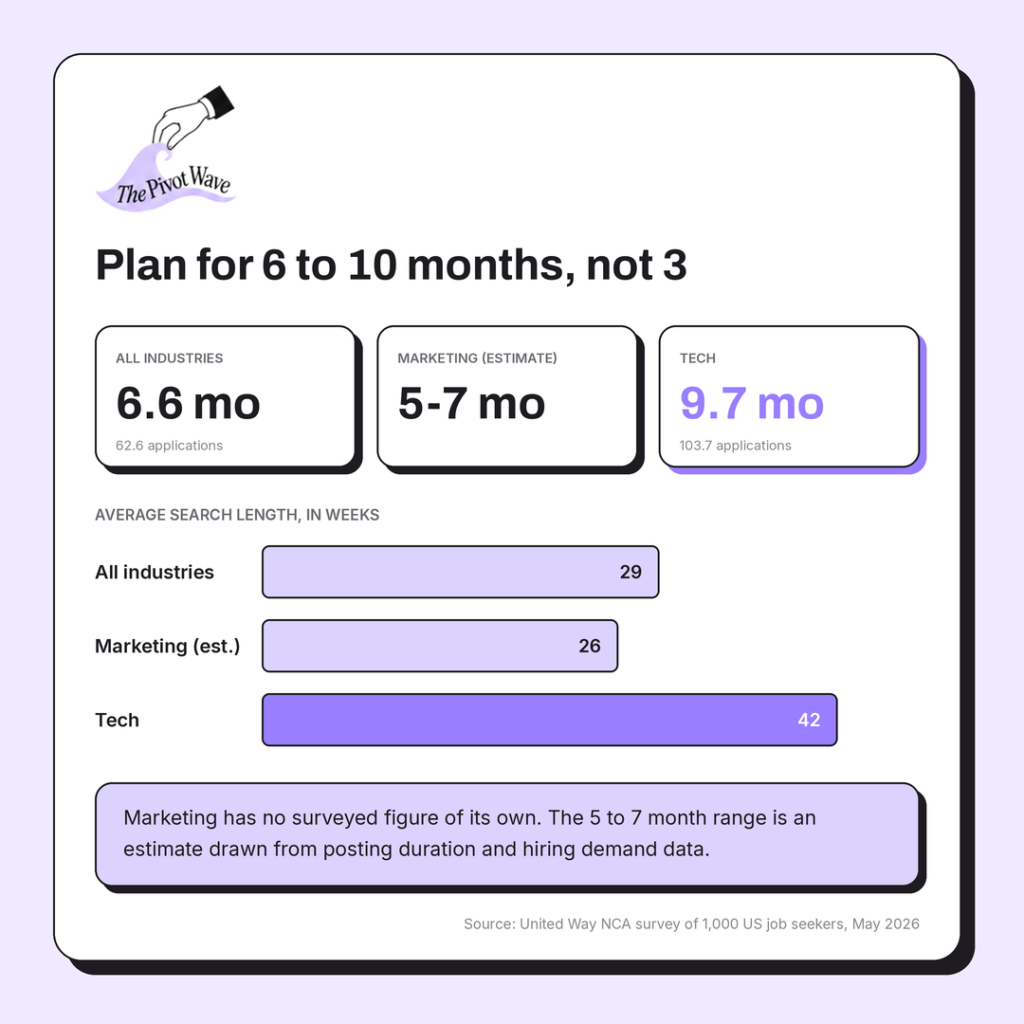
Plan for 6 to 10 months, not 3. United Way NCA’s survey of 1,000 US job seekers put the overall average at 6.6 months and 62.6 applications, with tech the slowest industry measured at 9.7 months and 103.7 applications.
For marketing roles, it’s 5 to 7 months, closer to the overall average than to tech’s 9.7.
The number most articles give you is the wrong one
Search this question and you get two answers that seem to contradict each other. One set of pages says ten to twelve weeks. Another says six months. Both are quoting the same Bureau of Labor Statistics table.
The gap is median versus mean. The BLS median duration of unemployment has hovered around ten weeks; the mean has run at roughly 23 to 26 weeks. Dexian’s April 2026 breakdown of the BLS numbers puts the early-2026 average at 25 to 26 weeks against a median near 11 to 12 weeks. A long tail of very extended searches drags the average up. In June 2026 the BLS counted 1.9 million people unemployed for 27 weeks or more, 27.3% of everyone unemployed, up 286,000 over the year.
Two more things that median doesn’t tell you. It measures everyone unemployed, across every occupation, so short retail and hospitality searches pull it down. And it measures how long people have been searching at survey time, not how long a finished search took. If you are a mid-level marketer or a software engineer, the median is the wrong benchmark twice over.
How long a tech job search actually takes in 2026
Tech is the slowest-moving white-collar category anyone has measured recently.
United Way NCA surveyed 1,000 US job seekers between February and March 2026. Overall average search length: 28.5 weeks, or 6.6 months. Tech: 9.7 months, the longest of any industry in the study by a wide margin. Construction, manufacturing and hospitality came in between 3.7 and 4.2 months.
The application volume is worse than the duration. Tech respondents reported 103.7 applications on average and 69.9 total hours spent applying, the highest time cost of any industry. The overall sample averaged 62.6 applications at 44 minutes each.
Two forces are stacking. Years of layoffs pushed experienced people back into the pool, so every posting draws candidates who already have the exact job on their CV. At the same time, companies are hiring more selectively and shifting budget toward AI-adjacent skills, which shrinks the pool of roles a traditional profile fits.
How long a marketing job search takes in 2026
Here is the honest answer: nobody has published a marketing-specific search duration. Anyone who gives you one has made it up or borrowed the general average. What we do have is a set of signals pointing the same direction.
Postings stay open longer. One analysis of Q1 2025 marketing listings put the average time a marketing role stayed posted at 31 days, five days longer than the year before. Employer-side data from BambooHR’s State of Hiring 2026 shows the average posting-to-hire clock across all roles climbing from 29 days to 48 days in three years.
Competition is up sharply. Applicants per job posting nearly doubled since 2021, from 46 to 95, and roughly a third of roles opened in 2025 were never filled at all. That last number matters: you can run a clean process on a role that simply evaporates.
Demand is genuinely split. Robert Half’s 2026 research found 65% of marketing and creative leaders planning to expand permanent headcount, with 45% saying skilled professionals are harder to find than a year ago. Addison Group’s 2026 guide reports digital marketing hiring volumes still around 25% below pre-pandemic levels, with the strongest demand for market research analysts, digital marketing managers, SEO specialists and AI/automation roles. Trust Insights, looking at JOLTS data in July 2026, found marketing hiring demand falling across almost every major market.
Read together: specialist and senior marketing roles are moving; generalist mid-level roles are the bottleneck. A reasonable planning number for a mid-level marketer is five to seven months, closer to the overall average than to tech’s 9.7. Treat that as a planning figure, not a measured one.
Where the months actually go
The wait is not one long silence. It is five separate queues, and knowing which one you’re stuck in tells you what to fix.
| Stage | Typical length | What’s actually happening |
|---|---|---|
| Getting your materials ready | 1–3 weeks | CV rewrite, portfolio, LinkedIn, target list |
| Application to first response | 1–3 weeks | ATS screening, then a recruiter working through hundreds of applicants |
| Recruiter screen | 1–2 weeks | Mostly scheduling friction, not evaluation |
| Interview rounds | 2–5 weeks | Two to four rounds, more stakeholders, more calendars to align |
| Offer and negotiation | 1–2 weeks | Internal sign-off, comparison against other finalists, then your counter |
That adds to roughly six to fifteen weeks per opportunity you take all the way through. The reason searches run six months and not three is that most applications die in queue two, and you run several of these cycles in parallel and in sequence before one lands.
Remote and hybrid hiring lengthened the middle. Video calls made it easy to add a fifth interviewer, and every added stakeholder adds a scheduling week.
The bottleneck is response rate, not application count
This is the finding that should change how you spend your week.
United Way NCA respondents submitted 62.6 applications and landed 4.76 interviews in total. About 67% of applications got no response at all, and 94.3% of people said they applied somewhere and never heard back. More than four in ten made it to final rounds and were still rejected. Just over a third were asked to complete unpaid assessments.
Applying more is the obvious response and mostly the wrong one. Tech job seekers already apply at 103.7 per search and still take the longest of any industry. Volume without a referral is the slow path.
The fast path is a warm introduction. A recruiter who is actively filling a role can put your CV in front of a hiring manager the same week, sometimes before the job is posted publicly. A referral from someone inside the company skips the ATS queue entirely. If you have 20 hours a week for the search, spending eight of them on people rather than portals will do more for your timeline than doubling your application count.
The part nobody plans for: your savings run out first
The financial timeline is shorter than the search timeline, and this is where the whole thing goes wrong.
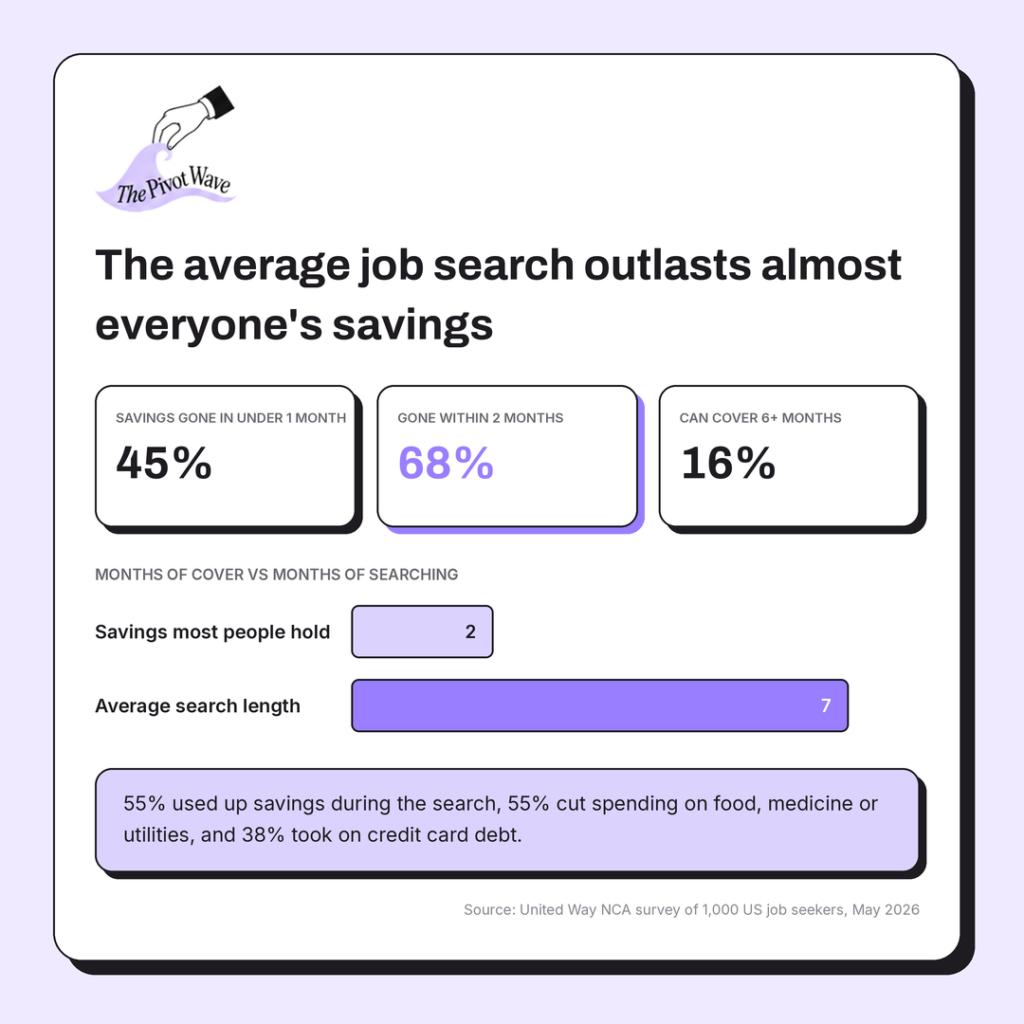
In that same survey, 45% of job seekers said their savings would run out in under a month if income stopped. 68.3% said they would not make it past two months. Only 16% could cover six months. The average search runs 6.6 months.
The consequences were predictable and widespread: 55.6% used up savings, 55.1% cut spending on food, medicine or utilities, 42.6% borrowed from family or friends, 37.8% took on credit card debt. Nearly 80% reported burnout, rising to 83% among people who had been laid off.
If you are still employed and considering a move, the practical read is to start the search before you need it. If you have already been laid off, build the freelance or contract bridge in month one rather than month four. More than half of unemployed respondents turned to gig or freelance work, and the ones who set it up early were not making decisions under the pressure of a deadline.
How to compress the timeline
Narrow before you broaden. Decide the two or three role titles you’re actually going for, at a defined level and salary band. A tight target list makes referrals askable. “I’m looking for anything in marketing” is unforwardable.
Rewrite the top third of your CV for each application. Recruiters scan the first few lines. If the posting names specific tools, certifications or channels, those belong above the fold, not buried in role three. AI makes this a two-minute job rather than a twenty-minute one, which is the difference between doing it every time and doing it never.
Run the pipeline in parallel. Waiting on a promising final round before applying elsewhere is how a two-month search becomes a five-month one. Keep applying until you have signed.
Ask about the process in the first call. How many rounds, who signs off, what’s the target start date. A company that can’t answer is a company whose role may join the third that never gets filled.
Ask for the job at the end of the interview. Directly, in the room or on the call. Most candidates don’t, and it costs nothing.
When to change strategy instead of trying harder
The advice above assumes your process works and just needs volume and speed. At some point that assumption fails, and the signal is in your conversion rates, not your calendar.
Applications out, no first responses, after 30-40 applications. Your CV or your targeting is off, not the market. Get three people in your target roles to read your CV cold and tell you what job they think you do. If they get it wrong, that’s the problem.
Screens but no first-round interviews. The recruiter conversation is losing you. Usually salary expectations, a location or notice-period mismatch, or a story about why you’re leaving that doesn’t land.
Final rounds and rejections, repeatedly. You’re competitive. This is close to a numbers problem, and it’s the point where a referral changes the outcome more than any CV edit will.
Four months in with no pattern at all. Widen the target: adjacent titles, a level down, contract-to-hire, or a smaller company. Candidates flexible on title and work arrangement land faster. In a market where one in three postings never becomes a hire, rigidity costs months.
Frequently asked questions
Is nine months of searching in tech normal in 2026?
Yes. 9.7 months was the average for tech job seekers in United Way NCA’s 2026 survey, and tech was the slowest industry measured. A long search in tech right now is evidence about the market, not about you.
Does applying to more jobs make the search shorter?
Not much past a point. Tech job seekers apply at more than 100 per search and still take the longest. Roughly two-thirds of applications get no response at all. Referrals and recruiter relationships move the needle further than raw volume.
How many applications should I expect before an offer?
The 2026 survey average was 62.6 applications producing 4.76 interviews. Tech averaged 103.7. Plan for dozens, not a handful.
Does the BLS ten-week median apply to me?
Probably not. It covers every unemployed American across all occupations, including short retail and hospitality searches, and it measures search-in-progress rather than completed searches. For a professional role, the mean of 23 to 26 weeks is closer.
Is it faster to search while employed?
Usually yes, and the difference is mostly financial. You aren’t negotiating against a savings deadline, which means you can hold out for a better offer. The trade-off is fewer available hours, so a tight target list matters more.
Do recruiters make it faster?
When your background matches a role they are actively filling, yes, often significantly. They know the internal urgency and can submit you before the posting goes public. When your background doesn’t match what’s on their desk, they can’t manufacture a role for you.
The bottom line
Budget six to ten months for a tech search and five to seven for marketing, then work to beat it. The thing that most reliably shortens the search is not a better CV or a higher application count, it’s a warm introduction to someone who already has an open role. Build the financial bridge early, because 68% of job seekers can’t cover two months and the average search runs past six. And check your conversion rates monthly: no responses, no interviews and no offers are three different problems with three different fixes.
Data sources
United Way NCA 2026 job seeker survey (1,000 US respondents, fielded February–March 2026), US Bureau of Labor Statistics Employment Situation June 2026, BambooHR State of Hiring 2026, Robert Half 2026 research, Addison Group 2026 workforce planning guide. Marketing-specific search duration is an estimate drawn from adjacent data, not a surveyed figure.