

How big is online learning in 2026, and what is actually true? Reports put the online education market at about $281 billion this year. In the US, 54% of college students take at least 1 online class. Coursera and Udemy have merged to offer all their courses via a single platform since May 2026. Coursera alone has over 205 million registered users as of the end of Q1 2026.
In 2026, online education is worth about $281 billion (Statista), and the AI-driven parts of the market are growing much faster than the market as a whole.
The statistics collected will be useful for students choosing between an online course and in-person classes; companies setting a budget for employee training and development; or professionals planning to master new skills.
Below, we offer an overview of the most important e-learning data, as well as key trends in the online learning industry in 2026.
Online learning statistics: the highlights
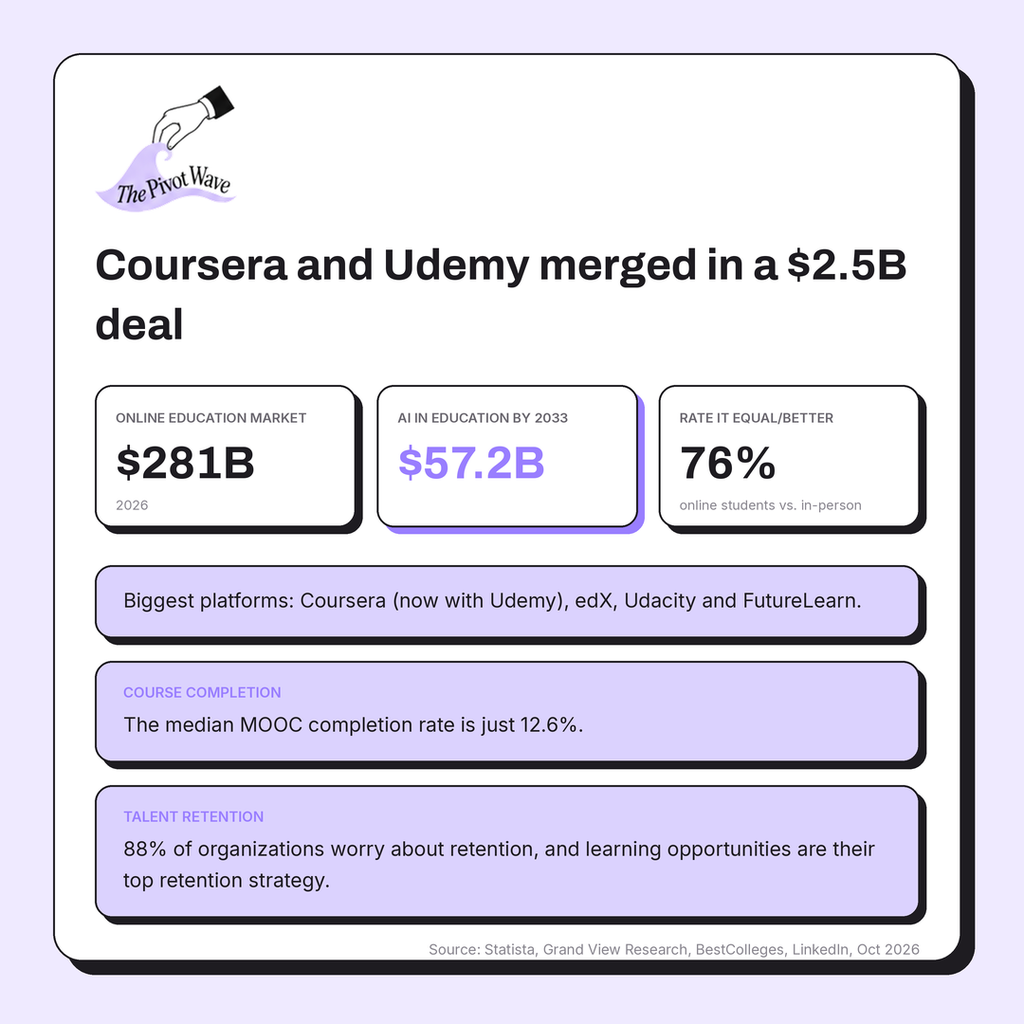
- The online education market is expected to hit $280.99 billion by the end of 2026 (Statista).
- 54.7% of US college students took at least one online class in Fall 2024, and 26.5% studied fully online (NCES).
- Coursera completed its merger with Udemy in May 2026; the company is now worth about $2.5 billion (Coursera).
- Coursera had 205 million learners signed up and took in $196 million in revenue by the end of Q1 2026 (Coursera).
- AI in education was an $8.3 billion market in 2025 and is forecast to reach $57.2 billion by 2033 (Grand View Research).
- 94% of employers say they would offer a higher starting salary to a graduate with a microcredential (Coursera, 2026).
- 76% of online students reckon the experience was just as good – if not better – than in-person, and 98% would recommend it (BestColleges).
- The 5 biggest e-learning platforms at the moment are Coursera, Udemy (now part of Coursera), edX, Udacity, and FutureLearn.
- The median MOOC completion rate is 12.6%, and 52% of people who register never open the course (Jordan; Reich and Ruipérez-Valiente).
The online learning market in 2026, by the numbers
Market-size figures for online learning scatter widely. Different analysts draw the line around “online learning” in different ways. Below are the latest figures pulled from specific reports, along with how each report defines the category.
| Segment | 2025 / 2026 value | Forecast | Source |
|---|---|---|---|
| Online education revenue (consumer courses, tutoring, certifications) | $281 B (2026) | — | Statista |
| EdTech market (all education tech) | $187.0B (2025) | $437.5B by 2033, 10.8% CAGR | Grand View Research |
| E-learning services market | $353.0B (2025) | $1.485T by 2033, 19.9% CAGR | Grand View Research |
| AI in education | $8.3B (2025) | $57.2B by 2033, 25.9% CAGR | Grand View Research |
North America still holds the largest share of the EdTech market, at 36.1% in 2025 (Grand View Research).
👉 Key takeaway: The cleanest single number for the online learning market in 2026 is Statista’s $281 billion for online education revenue, or Grand View Research’s $187 billion for the wider EdTech market.
Online learning enrollment in the US
In Fall 2024, 54.7% of US college students – that’s 10.76 million people – signed up for at least one online course. About a quarter (26.4%, or 5.17 million students) studied fully online with no in-person classes. The remaining group was 18.8%, or 3.68 million learners. They took both online and campus courses (NCES). The numbers did not change much from Fall 2023 to Fall 2024. Therefore, this pattern is valid to this day.
The peak of the pandemic has passed, but the number of students taking classes online has not returned to 2019 levels. Back then, just 17.6% of students took everything online. Now the baseline sits much higher.
Graduate students lean online harder than undergraduates. Around 40% of postbaccalaureate students take every course online, against 23.8% of undergraduates. Working professionals returning for an advanced degree treat online delivery as the default now, not the backup option.
👉 Key takeaway: Online is the majority experience in US higher education. More than half of all college students touch it, and a quarter never set foot on campus.
MOOCs and the Coursera–Udemy merger
MOOCs moved from experiment to core infrastructure, and 2026 brought the biggest structural change in the sector’s history.
On May 11, 2026, Coursera completed its merger with Udemy, combining two of the three largest course platforms into a single company valued at approximately $2.5 billion (Inside Higher Ed). Coursera’s own numbers have already skyrocketed: it ended 2025 with 197 million registered students and $757 million in annual revenue, up 9% from the previous year. Fast forward to 2026, and the company had already raked in $196 million from 205 million learners in just the first quarter of the year (Coursera).
| Platform | Registered learners | Notes |
|---|---|---|
| Coursera | 205 million | Merged with Udemy, May 2026 |
| Udemy | 79 million | Now part of Coursera |
| edX | 100 million+ | Owned by 2U |
| FutureLearn | 22 million | Independent |
| Udacity | 21 million | Owned by Accenture |
The stated goal of the merger is building skills for the AI era, pairing Coursera’s university and enterprise credentials with Udemy’s instructor marketplace. For learners, the open question is whether the two catalogs and subscriptions get consolidated over 2026-2027.
Most popular subjects
The most popular subjects to study online, based on platform enrollment data, are artificial intelligence and machine learning, data science and analytics, software development and programming, and business and management (ClassCentral). AI topics moved to the top of that list over the past three years and have stayed there.
Despite all that growth, though, the ‘completion’ picture isn’t all that bright. Studies have shown that across MOOCs, roughly 12.6% of enrolled learners finish the course (K. Jordan Study). And almost half of those who sign up (52%) never progress beyond registration (Reich and Ruipérez-Valiente study).
Structure changes the picture. On the Ruzuku platform, coaching courses with a fixed schedule reach 77% completion, against 38.5% for open, self-paced ones. That gap is the real lesson for anyone designing a course.
👉 Key takeaway: Coursera & Udemy now have a massive pool of learners that’s bigger than any other online course platform. AI is now officially the most popular subject people want to learn about online. Online course completion rates remain low at 12.6%.
AI in online education
AI is playing a bigger and bigger role in how online learning is delivered, with more and more courses incorporating tools like adaptive pacing, automated grading, content recommendations, and chat-based tutoring being standard features now.
The market for AI specifically designed for education just keeps on growing. It was worth $8.3 billion in 2025 and is forecast to grow to $57.2 billion by 2033 at a 25.9% CAGR (Grand View Research). Grand View expects $11.4 billion in 2026. A separate forecast from The Business Research Company puts 2026 at $10.6 billion, reaching $42.48 billion by 2030.
On the demand side, adoption inside corporate learning is real and fast. LinkedIn’s 2025 Workplace Learning Report found a majority of L&D teams are now exploring or already using AI in their programs, and companies that build AI into training report measurably better knowledge retention and faster program delivery.
Synthesia notes that AI has become a key asset for learning and development (L&D) teams in creating voiceovers (63%), developing training materials and assessment tests (60%), producing video content (52%), and translating training materials (38%). Among teams using AI, 84% report faster production and 66% report a better learner experience (Synthesia AI in L&D Report 2026).
For a closer look at how this plays out for workers, see our data on AI and the job market.
👉 Key takeaway: AI is already the engine behind personalization and assessment in online learning. The market is growing fast, and it is a $10.6–11.4 billion market in 2026.
Corporate online learning
Corporate e-learning has gone from a nice-to-have to a standard part of how teams learn. This shift is pushed by skills that change quickly and by the fight for strong talent. Grand View Research report puts the market at $151.7 billion in 2026, with a forecast of $335.0 billion by 2030, at a 21.7% CAGR.
US companies alone spent $102.8 billion on training in 2024–25, up about 5% year over year, averaging $874 and 40 hours of training per employee (Training Magazine 2025).
The business case shows up in retention and profit. In LinkedIn’s 2025 Workplace Learning Report, 88% of organizations named learning opportunities as their top retention strategy. Gallup finds that companies investing strategically in development are twice as likely to keep employees and report 11% greater profitability. The constraint is time: the average employee has only a few minutes a week to spend on learning, which is why short, mobile modules win inside companies. For programs built around this, see our roundup of AI corporate training programs.
AI is the fastest-moving piece. Generative AI course enrollments grew 195% year over year (Coursera 2025), and 71% of L&D professionals are already experimenting with or integrating AI (LinkedIn 2025). Yet roughly 7 in 10 workers have had no formal AI training at all (The Access Group / YouGov), which is the gap most companies are now racing to close.
👉 Key takeaway: Corporate e-learning is a $150 billion market in 2026 and growing above 20% a year. The returns show up in retention, with 88% of organizations naming learning opportunities as their main retention strategy. Meanwhile, there’s still a gap in AI training, as most workers have no formal training.
Learning management systems, or LMS
An LMS now serves as core infrastructure for online training at many companies, universities, and schools. Today, its implementation in large organizations is virtually universal.
Market figures also paint a picture of steady growth & the LMS market is just going to keep on getting bigger. Grand View Research is saying the market will hit $34.1 billion by the end of 2026. And by 2033, they predict it will have grown to $123.8 billion. And the growth rate? A pretty steady 20.2% CAGR.
Yet this is not mainly about new buyers. Training Magazine 2025 says only 14% of firms plan to buy an LMS in the next year. When it comes to upgrading for 2026, the most common drivers are pretty consistent across the board. They usually include AI personalization, mobile-first design, support for microlearning, and automated compliance training.
👉 Key takeaway: LMS will become standard for mid-sized and large organizations by the end of 2026. Today’s upgrade features include AI personalization, mobile-first design, microlearning support, and automated learning for compliance. The forecast estimates the LMS market at $123.8 billion by 2033.
Trends shaping online learning in 2026
There are a few big changes on the horizon this year, changes that could well shape the way courses are built, picked, and valued by employers. And fortunately, these are backed up by proper data.
1. Agentic AI and learning inside the workflow
The AI era is no longer only about chatbots. Agentic AI, systems that take actions on your behalf rather than just answer questions, is one of the fastest-growing skill areas of 2026 (Coursera). Even Coursera integrated its courses directly into ChatGPT through an OpenAI partnership. This makes learning feel less like a separate task in another tab. It happens within the tools many people already open each day.
2. Microcredentials are becoming a hiring signal
Short credentials moved from nice-to-have to something employers act on. In Coursera’s 2026 Micro-Credentials Impact Report, which surveyed 3,500 people across seven countries, 87% of microcredential holders landed a job in their field within a year, and 94% of employers said they would offer a higher starting salary to a candidate who holds one. The AI angle is sharper still. In Coursera’s 2025 edition of the report, 3 in 4 employers said they would hire a less experienced candidate with a GenAI credential over a more experienced one without it, yet only 17% of students had earned one. On the demand side, 71% of students said they would enroll in a program offering credit-bearing microcredentials, against 35% for programs without them.
3. Skills-first hiring is pushing out the degree requirement
These numbers are reflected in the published forecasts. The World Economic Forum, in its Future of Jobs Report of 2025, projects that 40% of current skills will change by 2030, and 63% of employers name skills gaps as their main transformation barrier.
4. AI deployment is getting more grounded
The hype phase is giving way to practical use. Schools and universities are putting AI to work on course building, scoring, and saving teacher time. Instead of making broad promises like “everything will be personalized,” they are focusing more on management systems and proof of learning gains (HolonIQ).
Money is moving in the same direction. In 2025, EdTech raised $2.6 billion. In early 2026, investors are backing AI-enabled, career-aligned platforms that deliver measurable results (HolonIQ).
👉 Key takeaway: The through-line for 2026 is career value. Agentic AI skills, microcredentials that employers reward, and skills-based hiring all point the same way. Online learning is being judged by whether it gets you hired, and the data says microcredentials increasingly do.
5. Mobile learning
Mobile is where most people now access the internet in the first place, and the major e-learning platforms adapted a long time ago.
The mobile learning market itself is harder to pin down, because estimates diverge sharply. Mordor Intelligence values it at $110.99 billion in 2026, growing at a 15.89% CAGR to reach $232 billion by 2031.
What the behavioral data agrees on is the shape of mobile learning, not precise percentages. Mobile sessions are short, often a few minutes at a time, versus the longer sittings desktop tends to get. Because of that, microlearning pairs well with mobile design. Short lessons match how people actually consume content on their phones.
👉 Key takeaway: Mobile-optimized, short-format learning is the new standard for online courses, and many learners now use their phones to study.
5. Microlearning and gamification
Two design choices consistently improve how online content performs: microlearning (short, focused modules) and gamification (game mechanics applied to learning). Both have solid data behind them.
Microlearning modules finish at far higher rates than long courses, and the format suits mobile use because a short lesson fits a short session. A large majority of organizations now treat microlearning as a core part of their training strategy.
Gamified training is what helps to hold learners’ attention. Programs that add points, streaks, and progress mechanics report much higher completion and engagement than plain content libraries, and employees are more likely to stay with employers that make learning feel less like a chore. The effect is strongest when the game layer supports a real goal rather than decorating a boring course.
👉 Key takeaway: Gamification and microlearning are now established standards in online learning. Gamification keeps learners engaged and lifts completion, while microlearning fits study into short, on-the-go sessions.
Online learning vs. traditional learning
The online-versus-campus debate gets less black and white every year, but the two formats still differ in ways that matter when you choose between them.
In BestColleges surveys, 75% of online graduates rate their education as equal to or better than in-person, 96% would recommend online learning, and 93% report a positive return on investment. Both formats have their pros and cons: online education leads on flexibility and access, in-person leads on connection and hands-on practice. Most institutions now run at least some courses in a blended format.
Where online learning wins
Students are mostly happy with it. In BestColleges’ 2025 survey, 76% of online students said online learning is as good as or better than studying on campus, and 98% would recommend it to others. Among online graduates, 90% say their degree has paid off or will.
The reasons people give haven’t changed in years: they can study around a job or family, and they can set their own pace. For working adults, that flexibility is often the only reason going back to school is possible at all.
Where e-learning falls short
The biggest weakness is finishing. The median MOOC completion rate is 12.6% (Jordan), and 52% of people who register for a course never open it (Reich and Ruipérez-Valiente). Learners also report feeling cut off from instructors and classmates, and many still find course apps awkward to use on a phone. That’s a real problem when most people study on their phones.
In-person study keeps its edge on social contact and hands-on practice, which is why so many colleges now run blended programs that mix the two.
What makes online learning successful
Structure is what makes the difference. On the Ruzuku platform, coaching courses with a fixed schedule reach 77% completion, against 38.5% for open, self-paced ones. Clear deadlines, a cohort to learn with and short lessons that work on a phone all push in the same direction.
👉 Key takeaway: Most online students rate their education as good as or better than in-person, but completion is still the weak spot, with a median of 12.6% for MOOCs. Courses with fixed schedules and coaching close most of that gap, so look for structure before you enroll.
A brief history of e-learning
The growth numbers land harder once you see how young the mass-market version of this industry really is.
- 1960: The University of Illinois builds PLATO, the first online learning system.
- 1994: CompuHigh becomes the first fully accredited online high school in the US.
- 1999: Elliott Masie coins the term “e-learning” at the TechLearn conference.
- 2008: Dave Cormier coins the term “MOOC.”
- 2011: Stanford’s free “Artificial Intelligence” course draws 160,000 students.
- 2012: The “Year of the MOOC,” as Coursera, Udacity, and edX all launch.
- 2020: COVID forces a global shift online and produces the largest traffic spike in the sector’s history.
- 2022: OpenAI releases ChatGPT, and generative AI reaches education almost overnight. Schools and universities scramble to respond, and AI tutoring, drafting, and grading tools move from novelty to standard within two years.
- 2026: Coursera and Udemy merge, consolidating the MOOC market around a single leader.
ChatGPT changed things fast. It feels like one of the biggest turns in this timeline since COVID. AI assistance shifted the debate from whether AI should be in online learning to how to use it well. This change has forced platforms to integrate tutoring and personalization features directly into the product, rather than adding them as separate add-ons.
We can see as a result that on Coursera, enrollments for generative AI classes jumped 195% year over year (Coursera Global Skills Report 2025), and in 2025 they nearly doubled again to 5.4 million. That is what the change looks like in the numbers.
👉 Key takeaway: E-learning is about 65 years old as an idea and roughly 15 as a mass-market industry. Two forces are shaping its current phase: the 2026 Coursera–Udemy merger consolidating the platforms, and generative AI rewriting how courses are built and taught.
Frequently asked questions
How big is the online learning market in 2026?
The online education market is projected at $281 billion in 2026 (Statista). However, figures can vary widely because each analyst defines the market differently.
Is online learning as effective as classroom learning?
On outcomes and satisfaction, it holds up well: 75% of online graduates rate it equal to or better than in-person, and 96% would recommend it (BestColleges). Ignore the widely shared claim that online learning triples retention versus a classroom. That statistic comes from a debunked source. In-person still has the edge on hands-on practice and social connection.
Did Coursera and Udemy merge?
Yes. Coursera completed its combination with Udemy in May 2026, creating a company worth around $2.5 billion (Inside Higher Ed). Coursera ended 2025 with 197 million registered learners. Any platform comparison from before 2026 that lists them as separate leaders is out of date.
What is the MOOC completion rate?
Around 12–15% across platforms, and more than half of registrants never move past sign-up. Programs that add coaching, deadlines, and community push completion above 70%.
How many US students learn online?
In Fall 2023, 54.3% of US college students (about 10.38 million) took at least one online course, and 26.4% studied exclusively online (NCES).
How large is the AI-in-education market?
About $8.3 billion in 2025, forecast to reach $57.2 billion by 2033 (Grand View Research).
The bottom line
Online learning in 2026 is the default channel for both formal education and workplace training, not an alternative to it. The market is around $281 billion, more than half of US college students study at least partly online, and the platform side just consolidated around a merged Coursera and Udemy. The open problems are the same as they have been: completion, motivation, and connection, and the programs solving those will pull ahead. If you are weighing whether to invest in online learning for your own career, the direction of the data is not subtle. It is where work and study are heading.
Sources
Market size- Statista – Online Education: Worldwide market outlook
- Grand View Research – Education Technology Market Report, 2026–2033
- Grand View Research – E-learning Services Market Report, 2026–2033
- Grand View Research – AI in Education Market Report, 2026–2033
- The Business Research Company – AI in Education Global Market Report 2026
- Grand View Research – Corporate E-learning Market Report, 2025–2030
- Grand View Research – Learning Management System Market Report, 2026–2033
- Mordor Intelligence – Mobile Learning Market Size and Share, 2026–2031
- Eurostat – Online learning increasingly popular in the EU (March 2026)
- NCES – Digest of Education Statistics, Table 311.15 (Fall 2024)
- Inside Higher Ed – New U.S. data show jump in college students learning online
- Coursera – Form 8-K/A, completion of the Udemy combination (SEC, May 2026)
- Reworked – Coursera Closes $2.5B Udemy Merger
- Coursera – Fourth Quarter and Full Year 2025 Financial Results
- Coursera – First Quarter 2026 Financial Results (SEC)
- Udemy – First Quarter 2025 Results
- edX – A 100 Million Learner Network (February 2026)
- FutureLearn – Wikipedia
- Accenture – Accenture Completes Acquisition of Udacity
- Jordan, K. (2015) – Massive open online course completion rates revisited, IRRODL
- Reich, J. & Ruipérez-Valiente, J. A. (2019) – The MOOC Pivot, Science
- Ruzuku – Online Course Completion Rates
- Synthesia – AI in Learning & Development Report 2026
- Coursera – 2026’s fastest-growing skills and top learning trends from 2025
- Coursera – Making Coursera learning more accessible through an app in ChatGPT
- Coursera – Micro-Credentials Impact Report 2026
- Coursera – Micro-Credentials Impact Report 2025
- Coursera – Global Skills Report 2025
- World Economic Forum – The Future of Jobs Report 2025
- HolonIQ – EdTech hits $2.6B in investment as the market stabilizes
1 Comment