The debate over artificial intelligence and employment has moved well past speculation. In 2025 and 2026, hard data from Harvard Business School, the World Economic Forum, Goldman Sachs, the Dallas Fed, PwC, and Challenger, Gray & Christmas is painting a nuanced picture of how AI is actually transforming work. And some data can be surprising.
Quick answer
Is AI creating or destroying jobs in 2026?
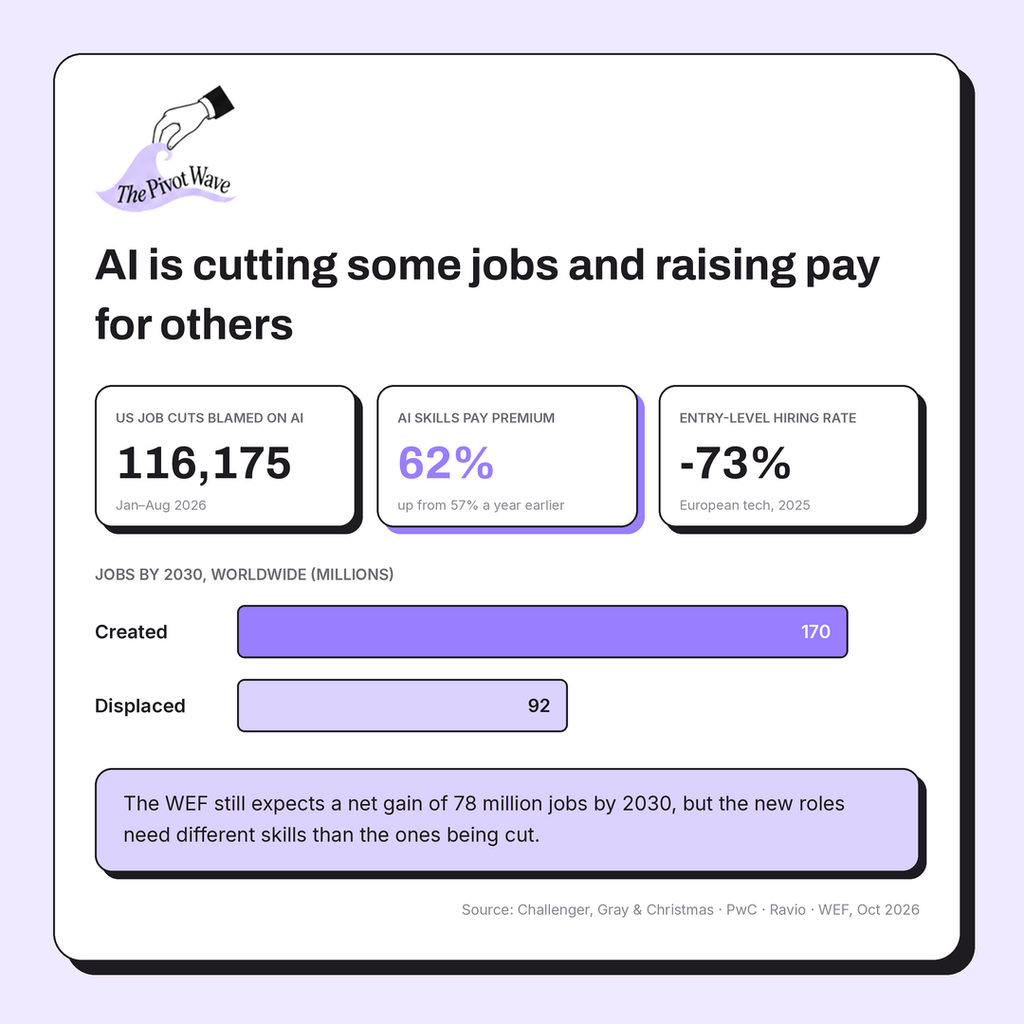
Both — it’s creating and cutting at once. The WEF projects 170 million new jobs and 92 million displaced by 2030, a net gain of 78 million, while AI was the leading stated reason for US layoffs in 2026 with 116,175 cuts through August.
Workers with AI skills earn a 62% wage premium; entry-level hiring in tech fell 73%. The market isn’t shrinking — it’s splitting.
Here’s what the numbers reveal, who’s gaining ground, who’s falling behind, and what workers and businesses need to do next.
AI and job market statistics: the highlights
- The WEF expects 170 million jobs to be created and 92 million displaced by 2030, a net gain of 78 million (WEF Future of Jobs Report 2025).
- US employers attributed 116,175 job cuts to AI from January to August 2026, about 22% of all announced cuts and still the top reason for the year (Challenger, Gray & Christmas).
- Workers with AI skills earn a 62% wage premium over peers in the same roles, up from 57% a year earlier (PwC, 2026).
- Jobs requiring AI skills grew 69%, against 9% for the job market as a whole (PwC, 2026).
- The most AI-exposed companies grew headcount 52% since 2018, compared with 36% for the least exposed (PwC, 2026).
- The entry-level hiring rate at European tech companies fell 73.4% in a year, from 35% to 8% (Ravio).
- Workers aged 20–24 in the most AI-exposed US occupations saw their employment share slip from 16.4% to 15.5% between November 2022 and September 2025 (Dallas Fed).
- Job postings for routine, automation-prone roles fell 13% after ChatGPT launched, while demand for analytical, technical and creative roles grew 20% (Harvard Business School).
- Workers can expect 39% of their existing skills to change or become outdated by 2030 (WEF Future of Jobs Report 2025).
The Big Picture: More Jobs Created Than Destroyed, But the Transition Hurts
- 170 million new jobs expected by 2030, offset by 92 million displaced — a net gain of 78 million positions worldwide. (WEF Future of Jobs Report 2025)
- Routine job postings fell 13% post-ChatGPT, while analytical and creative role demand grew 20%. (Harvard Business School, February 2026)
The World Economic Forum’s Future of Jobs Report 2025, drawing on insights from over 1,000 global employers representing 14 million workers, projects that 170 million new roles will emerge by 2030, while 92 million existing positions will be displaced. That’s a net gain of 78 million jobs globally. But the headline masks a turbulent transition.
A Harvard Business School working paper, covered by HBS Working Knowledge in February 2026, analyzed nearly all US job postings from 2019 to March 2025 and found that openings for routine, automation-prone roles declined 13% after ChatGPT launched in November 2022, while demand for analytical, technical, and creative positions grew 20%. The labor market isn’t shrinking — it’s splitting.
Goldman Sachs Research estimates that 300 million jobs globally are exposed to AI automation. For the US, economist Joseph Briggs’ base case is that 6–7% of workers will be displaced over a roughly 10-year adoption period, adding about 0.6 percentage points to the unemployment rate. But economist Joseph Briggs has cautioned that if the transition is frontloaded, the economic disruption could be significantly larger.
The AI Salary Premium Is Surging
- AI-skilled workers now earn 62% more than non-AI peers in equivalent roles — up from 56% a year ago and 25% two years ago. (PwC 2026)
- Jobs requiring AI skills are growing 69% year over year, against 9% for the overall job market. (PwC 2026)
Workers who’ve developed AI expertise are commanding historically large wage premiums, and the gap keeps widening. PwC’s Global AI Jobs Barometer, based on analysis of over a billion job advertisements across 27 countries, found in June 2026 that AI-skilled workers earn 62% more than peers in equivalent roles without those skills. A year earlier the premium was 56%. Two years earlier it was 25%. The premium varies widely by industry — as high as 118% in consumer markets, and 16% in government and public sector work.
The demand side keeps outrunning supply. Jobs requiring specific AI skills — prompt engineering, machine learning, LLM operations — grew roughly eight times as fast as the overall jobs market in the past year (69% vs. 9%, per PwC). Ravio’s compensation data across European tech shows a 12% salary premium for AI/ML roles and an 88% year-over-year jump in AI/ML hiring.
Research by Fabian Stephany of the Oxford Internet Institute, published on the World Economic Forum’s site in February 2026, found that AI skills now pay more than formal credentials. Across more than 10 million UK job postings, AI skills carried a 23% advertised salary premium, compared with about 13% for a master’s degree. In hiring experiments, AI skills helped offset age and education disadvantages — older applicants and candidates without advanced degrees saw improved callback rates when AI skills appeared on their résumés.
Young Workers, Admin Roles, and Entry-Level Positions Are Losing to AI
- Entry-level hiring plunged 73.4% and admin role hiring dropped 35.5% in 2025, with half of employers citing AI automation as the cause. (Ravio 2026)
- Young workers’ employment share in AI-exposed occupations fell from 16.4% to 15.5% since ChatGPT’s launch. (Dallas Fed, January 2026)
The flip side of the AI boom is stark. Research from the Dallas Federal Reserve, published in January 2026, found that employment for young workers (ages 20–24) in AI-exposed occupations declined from 16.4% to 15.5% of employment share between November 2022 and September 2025. This decline isn’t driven by layoffs — it’s driven by employers simply not hiring young workers into those roles in the first place.
The job-finding rate for young workers entering high AI-exposure occupations dropped by more than 3 percentage points since its November 2023 peak. The front door to many knowledge-economy careers is quietly narrowing — and PwC’s 2026 Barometer explains part of why: AI-exposed entry-level roles are now seven times more likely than other entry-level jobs to require traditionally senior-level skills like judgement and leadership. The bottom rung hasn’t disappeared so much as moved up.
That narrowing shows up directly in how long it takes to get hired. The average tech job search now runs 9.7 months and 103.7 applications — the longest of any industry measured in United Way NCA’s 2026 survey. We break down how long it takes to find a job in 2026, stage by stage, and where the months actually go.
Ravio’s 2026 analysis of hiring data across European tech companies tells a similar story across experience levels. Administrative role hiring decreased 35.5% year-over-year in 2025, and entry-level (P1/P2) hiring plunged 73.4%. When surveyed, half of reward leaders explicitly cited AI automation as the reason for deprioritizing administrative positions.
The displacement is no longer a projection — companies are naming AI in their layoff filings. Challenger, Gray & Christmas counted 116,175 AI-attributed job cuts in the first eight months of 2026, about 22% of all announced cuts and the leading stated reason for the year. Compare that with 54,836 in all of 2025 and 12,742 in 2024. Technology absorbed the most: 149,023 cuts through July, up 67% year over year and 31% of every job cut announced in 2026. One caveat that matters: AI dropped to the fourth-most cited reason in August, ending a five-month run at the top — a reminder that these announcements move in waves, not a straight line. We track the company-by-company detail in our live AI layoffs dashboard.
The Productivity Paradox: AI Makes Companies Richer, but Adoption Lags
- Productivity growth nearly quadrupled in AI-exposed industries (7% → 27%), while AI-lagging sectors saw growth decline. (PwC 2025)
- “Super-star” AI-exposed companies achieved 163% labour productivity gains — and grew headcount faster than everyone else. (PwC 2026)
One of the most striking findings from recent data is the growing productivity divide between AI-adopting and AI-lagging industries.
PwC found that productivity growth nearly quadrupled in AI-exposed sectors — from 7% during 2018–2022 to 27% during 2018–2024. Industries least exposed to AI, such as mining and hospitality, actually saw their productivity growth decline from 10% to 9% over the same period. By 2024, the most AI-exposed industries were generating three times higher revenue-per-employee growth than the least exposed.
PwC’s 2026 follow-up sharpened the picture. “Super-star” companies most exposed to AI achieved labour productivity gains of 163%, far outpacing everyone else — and, counter to the jobs-apocalypse narrative, the most AI-exposed companies grew headcount faster than the least exposed (52% vs. 36% since 2018). The companies using AI most are hiring more, not less. They’re just hiring different people.
Yet a massive gap remains between adoption and mastery. McKinsey’s 2025 State of AI report found that nearly 90% of organizations now use AI in operations, but Gartner reports only 9% have achieved true AI maturity. The companies that figure out how to bridge this gap stand to pull dramatically ahead.
The Skills Revolution: 39% of Today’s Skills Are Becoming Obsolete
- Skill demands are changing 66% faster in AI-exposed roles than in the least exposed — up from 25% the prior year. (WEF / PwC)
- Demand for prompt engineers surged 135.8% in 2025, and GenAI training enrollments on Coursera tripled year over year. (Autodesk / Coursera)
The World Economic Forum found that 39% of core skills required by the job market will change between 2025 and 2030. The skills gap is now the single largest barrier to business transformation, cited by 63% of employers surveyed.
Employers say they’ll respond mainly by retraining. In the WEF survey, 85% plan to prioritize upskilling their workforce. Asked about AI specifically, 77% plan to upskill staff to work alongside it, and two-thirds plan to hire people with specific AI skills.
Skills demanded by employers are changing 66% faster in AI-exposed occupations than in the least exposed roles — up from a 25% differential the previous year. Demand for prompt engineers surged 135.8% in 2025, alongside AI engineers (+143.2%) and AI content creators (+134.5%), per Autodesk’s AI Jobs Report. AI and big data skills now top the list of fastest-growing skill requirements, followed by cybersecurity and general technology literacy.
Online learning platforms show the same demand. Coursera’s CEO said the platform logged more than 7.4 million enrollments in AI courses in 2023, with generative AI the fastest-growing area.
Where the New Jobs Are Coming From
- AI/ML hiring grew 88% year-over-year in 2025, with demand expanding well beyond tech into healthcare, finance, and consulting. (Ravio 2026)
- Data center construction jobs have grown by 216,000 since 2022, driven by AI infrastructure investment. (Goldman Sachs)
Not all the news is about displacement. AI is actively creating roles in several sectors:
Infrastructure buildout. Construction jobs linked to data center development have grown by 216,000 since 2022, driven by surging investment in AI compute infrastructure. Goldman Sachs expects data center investment to continue expanding.
AI-specific roles. AI/ML hiring grew 88% year-over-year in 2025. The demand extends beyond tech companies — healthcare, consulting, financial services, and staffing firms are all racing to hire AI talent. McKinsey reports that three-quarters of AI skill demand is concentrated in computer and mathematical roles, management, and business and financial operations.
Green economy crossover. The WEF identified environmental stewardship as a top-growing skill for the first time, with AI-driven ESG reporting and sustainability roles emerging at the intersection of technology and climate work.
New specializations. Just as previous technological shifts created unforeseen professions, AI is spawning roles like LLM fine-tuning specialists, RAG pipeline engineers, AI ethics auditors, and prompt engineers — none of which existed five years ago.
What This Means for Workers and Businesses
- AI skills now deliver higher wage returns than a master’s degree in the U.K. (23% vs. 13% premium). (Oxford Internet Institute, February 2026)
- 89% of senior HR leaders expect AI to reshape roles in 2026, making workforce planning an urgent priority. (CNBC WEC Survey)
Goldman Sachs has called AI “the big story in 2026 in labor.” The data supports that claim, but with an important caveat: the impact is still concentrated rather than widespread. Employment shifts have been most pronounced in tech, creative, and knowledge work — sectors that represent a relatively small share of the total economy. The Bureau of Labor Statistics notes that technological displacement tends to unfold more gradually than technologists predict, and many affected occupations still see employment growth even as AI augments their tasks.
For workers, the message is clear: AI literacy is no longer optional — and neither is a realistic timeline. If you’re searching in tech or marketing, budget for a 6-to-10-month search, not three. Targeted skill acquisition — even through short, modular training — can boost wages more than a traditional degree in many cases. The premium goes to those who combine AI proficiency with domain expertise.
For employers, the imperative is strategic workforce planning. Companies that balance lean operations with competitive AI talent compensation are attracting both funding and the right people. Building flexibility into compensation through market premiums, equity packages, and retention bonuses is outperforming rigid base salary increases.
For policymakers, the IMF and WEF emphasize the need for redesigned education systems, expanded social protections for displaced workers, and investment in lifelong learning programs. Ireland, Finland and Denmark lead the IMF’s Skill Readiness Index, which covers 23 countries, thanks to high shares of tech graduates and strong adult retraining systems.
The Bottom Line
- Goldman Sachs estimates 300 million jobs globally are exposed to AI automation, with 6–7% of workers displaced over a decade. (Goldman Sachs)
- 40% of global jobs are exposed to AI-driven change — rising to 60% in advanced economies. (IMF, January 2024)
AI’s impact on the job market in 2025–2026 is neither the apocalypse some feared nor the seamless transition others promised. It’s a structural reshaping: routine roles are shrinking, AI-augmented roles are commanding historic pay premiums, young and entry-level workers are bearing disproportionate costs, and a massive skills gap separates companies that are pulling ahead from those falling behind.
The data is definitive on one point: the workers and organizations that invest in AI capabilities now will be the ones that thrive. The window for adaptation isn’t closing yet — but it’s narrowing fast.
Sources
- World Economic Forum — Future of Jobs Report 2025 (January 2025) — 170M created / 92M displaced / net +78M, 39% skills change, 63% skills-gap barrier, 85% upskilling plans
- PwC 2026 Global AI Jobs Barometer (June 2026) — 62% wage premium, 69% vs 9% job growth, 163% super-star productivity, 52% vs 36% headcount growth, 7x senior-skill requirement in entry-level roles
- PwC 2025 Global AI Jobs Barometer (June 2025) — 56% premium, productivity 7% → 27%, skills changing 66% faster
- Federal Reserve Bank of Dallas — Young workers’ employment drops in occupations with high AI exposure (January 2026) — employment share 16.4% → 15.5%, job-finding rate decline
- Federal Reserve Bank of Dallas — AI is simultaneously aiding and replacing workers, wage data suggest (February 2026) — wage growth in AI-exposed sectors
- Challenger, Gray & Christmas — August 2026 Job Cut Report (September 2026) — 116,175 AI-attributed cuts YTD, 22% of all cuts, AI fourth-most cited reason in August
- Challenger, Gray & Christmas — July 2026 Report (August 2026) — technology 149,023 cuts through July, +67% YoY, 31% of all cuts
- Ravio — AI compensation and talent trends 2026 — +88% AI/ML hiring, −35.5% admin, −73.4% entry-level, 12% AI salary premium
- Ravio — Early career hiring is down 73% — entry-level hiring rate 35% → 8% across European tech
- Autodesk 2025 AI Jobs Report (June 2025) — Prompt Engineer +135.8%, AI Engineer +143.2%, AI Content Creator +134.5%
- World Economic Forum / Oxford Internet Institute — How AI skills and experience are transforming the workplace (February 2026) — 23% AI-skills premium vs 13% master’s / 8% bachelor’s, 10M+ UK postings
- Goldman Sachs Research — 300 million jobs exposed to AI automation (2023); 6–7% displacement over a decade and data-center construction employment (2026 commentary)
- Harvard Business School Working Knowledge (March 2026) — routine postings −13%, analytical/creative demand +20% post-ChatGPT
- McKinsey — The State of AI 2025; Gartner AI maturity research 2025
- IMF — Gen-AI: Artificial Intelligence and the Future of Work (January 2024) — 40% of global jobs exposed, 60% in advanced economies
- CNBC Workforce Executive Council Survey — 89% of senior HR leaders expect AI to reshape roles in 2026
- United Way NCA 2026 job seeker survey (1,000 US respondents, February–March 2026) — 6.6-month average search, 9.7 months in tech
- Coursera platform data (2024) — AI and generative AI enrollment growth
- US Bureau of Labor Statistics — Employment Projections