

Are AI-related layoffs as bad as the headlines suggest? The scale is real. In 2025, companies directly attributed around 55,000 job cuts to AI (Challenger, Gray & Christmas), part of nearly 246,000 total tech layoffs, the most since the 2020 pandemic. 2026 passed that bar early: Layoffs.fyi’s count crossed its full-year 2025 total in the first week of August and now stands at 131,382 tech workers across 313 companies. Through September, US employers had blamed AI for 120,136 announced job cuts, about 21% of all cuts this year, and AI was the most-cited reason for five straight months, from March to July.
Then it fell down the list. In August, AI dropped to fourth place behind restructuring, and in September it was fifth, with 3,961 cuts or 9% of the month’s total. Tech layoffs didn’t stop (US tech-sector cuts reached 165,925 by the end of September, 54% more than at the same point in 2025), but fewer companies wanted to put AI in the press release.
So the picture is messier than either side admits. Some cuts are genuine AI displacement. Others are post-pandemic headcount corrections, with AI as the explanation investors like to hear, and lately the explanation companies avoid. What’s changing is which roles are most exposed (customer support, content, junior coding, administrative work) and how openly companies talk about it.
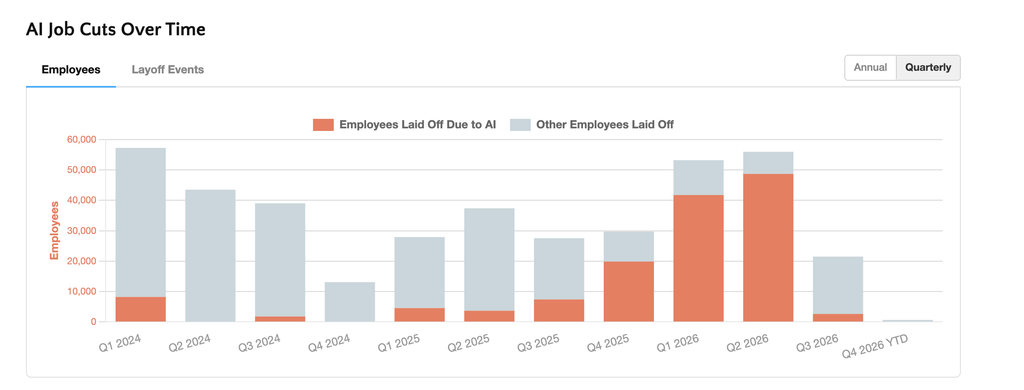
~37,600 of Q1 2026’s tech layoffs — 47.9% — were directly attributed to AI and automation by the companies themselves.
Biggest Tech Layoffs – Month by Month
The largest publicly reported tech-sector job cuts since late 2025. Pick a month to filter. Click a column header to sort.
Updated October 7, 2026| Company | Laid off ▾ | % of workforce | Industry | Date |
|---|---|---|---|---|
| SAP | 10,000 | ~9% | Enterprise software | Dec 2025 |
| HP Inc. | 6,000 | ~10% | Hardware / PCs | Dec 2025 |
| Salesforce | ~4,000 | ~5% | CRM / cloud | Dec 2025 |
| Uber | 150 | <1% | Mobility / apps | Dec 2025 |
| Google (Cloud) | 100+ | <1% | Cloud / internet | Dec 2025 |
| Company | Laid off ▾ | % of workforce | Industry | Date |
|---|---|---|---|---|
| Amazon | 16,000 | ~4% corp. | E-commerce / cloud | Jan 28, 2026 |
| Ericsson | 1,600 | 12%† | Telecom equipment | Jan 15, 2026 |
| Kaseya | 250 | 5% | IT management software | Jan 8, 2026 |
| Meta (Reality Labs) | – | ~10% of division | AR / VR | Jan 13, 2026 |
| Multiverse | dozens | – | EdTech | Jan 5, 2026 |
| Company | Laid off ▾ | % of workforce | Industry | Date |
|---|---|---|---|---|
| Salesforce | ~1,000 | ~1% | CRM / cloud | Feb 10, 2026 |
| eBay | 800 | ~6% | E-commerce / marketplace | Feb 26, 2026 |
| Workday | 400 | ~2% | HR / finance software | Feb 4, 2026 |
| Sonos | 100 | ~6% | Consumer audio / hardware | Feb 2026 |
| Company | Laid off ▾ | % of workforce | Industry | Date |
|---|---|---|---|---|
| Oracle | 30,000‖ | ~18% | Cloud / enterprise software | Mar 31, 2026 |
| Block | 4,000 | ~40% | Fintech | Mar 2026 |
| Atlassian | 1,600 | 10% | Collaboration software | Mar 12, 2026 |
| Wix | 1,000 | – | Web / SaaS | Mar 2026 |
| Company | Laid off ▾ | % of workforce | Industry | Date |
|---|---|---|---|---|
| Dell | 11,000 | ~10% | Hardware / PCs | Apr 2026 |
| Microsoft | ~8,750‡ | – | Software / cloud | Apr 23, 2026 |
| Intuit | 3,000 | 17% | Fintech / SaaS | Apr 2026 |
| Company | Laid off ▾ | % of workforce | Industry | Date |
|---|---|---|---|---|
| Meta | 8,000 | ~10% | Social / AI | May 20, 2026 |
| PayPal | 4,760§ | ~20% | Fintech | May 2026 |
| Cloudflare | 1,100 | ~20% | Cloud / security | May 2026 |
| Snap | 1,000 | – | Social media | May 2026 |
| Coinbase | 700 | ~14% | Crypto / fintech | May 2026 |
| Upwork | – | ~25% | Freelance marketplace | May 2026 |
| Company | Laid off ▾ | % of workforce | Industry | Date |
|---|---|---|---|---|
| ~875 | ~5% | Social / professional network | Jun 2026 | |
| Groupon | ~400 | ~25% | E-commerce / local | Jun 2026 |
| GitLab | ~350 | ~14% | DevOps / software | Jun 3, 2026 |
| Robinhood | 290 | ~10% | Fintech / trading | Jun 16, 2026 |
| Company | Laid off ▾ | % of workforce | Industry | Date |
|---|---|---|---|---|
| Microsoft | 4,800 | ~2.1% | Software / cloud (Xbox) | Jul 6, 2026 |
| Cisco | ~4,000¶ | – | Networking / software | Jul 2026 |
| ServiceNow | up to 1,000 | ~3% | Enterprise software / workflow | Jul 30, 2026 |
| Rackspace | 750 | ~15% | Cloud services | Jul 2026 |
| Company | Laid off ▾ | % of workforce | Industry | Date |
|---|---|---|---|---|
| Zillow | 500+ | ~7% | Real estate / proptech | Aug 4, 2026 |
| TikTok | ~325** | – | Social / e-commerce | Aug 2026 |
| Etsy | ~220 | ~12% | E-commerce / marketplace | Aug 5, 2026 |
| Apple | ~200 | <1% | Consumer hardware / software | Aug 21, 2026 |
| 52†† | <1% | Cloud / internet | Aug 5, 2026 | |
| LinkedIn (Tel Aviv R&D) | – | – | Social / professional network | Aug 2026 |
| Netflix (game studios) | – | – | Streaming / gaming | Aug 2026 |
| Company | Laid off ▾ | % of workforce | Industry | Date |
|---|---|---|---|---|
| Uber | ~3,300 | ~10% | Mobility / apps | Sep 2, 2026 |
| Oracle | ~800‡‡ | <1% | Cloud / enterprise software | Sep 14–17, 2026 |
| The Trade Desk | ~575 | ~15% | Ad tech | Sep 3, 2026 |
| Workday | ~525¶¶ | ~2.5% | HR / finance software | Sep 29, 2026 |
| Microsoft | ~500 | <1% | Software / gaming (Xbox) | Sep 22, 2026 |
| PayPal | 251§§ | – | Fintech | Sep 2026 |
| Trustly | ~200 | – | Fintech / open banking | Sep 17, 2026 |
| Booksy | ~200 | ~20% | Booking software | Sep 11, 2026 |
| Company | Laid off ▾ | % of workforce | Industry | Date |
|---|---|---|---|---|
| HubSpot | ~660 | ~7% | CRM / marketing software | Oct 6, 2026 |
| Snyk | 203 | ~20% | Developer security | Oct 1, 2026 |
| Anchorage Digital | 68 | ~17% | Crypto / banking | Oct 2, 2026 |
Notes. Figures are the largest publicly reported cuts per month and may be approximate or rounded; some are announced in waves or phased over time. October covers announcements up to October 7, 2026. † Ericsson's 12% refers to its Sweden-based workforce (1,600 roles). ‡ Microsoft's April figure is a voluntary early-retirement program (~8,750 employees eligible), not forced layoffs; the July cut (4,800, mostly Xbox/gaming) and the September cut (~500, including 268 Xbox roles) are separate. § PayPal's ~20% reduction (~4,760 roles) is planned over two to three years. ‖ Oracle's June 22, 2026 annual filing confirmed a net reduction of ~21,000 roles (~13%) over the year; 30,000 was the high end of early estimates. ¶ Cisco's ~4,000 cut falls in its fiscal Q4 (ending late July 2026). ** TikTok's August figure combines two rounds: ~250 roles from the Nashville content-moderation office closure (early August) and 75 Seattle-area e-commerce roles (late August, effective October). †† Google's August figure is a Washington-state WARN filing (52 roles, effective October 5) described by the company as a team-level reorganization, not a company-wide round. ‡‡ Oracle's September figure combines state WARN filings: 359 roles in Washington and 441 in California. §§ PayPal's September figure is a San José WARN filing (251 roles) under the multi-year plan in the May row. PayPal also cut ~220 roles in India on August 31 (early reports said 600; the company put it at ~4% of its India staff). ¶¶ Workday's September cut is its second round of 2026, after ~400 roles in February. Sources: Layoffs.fyi, TrueUp, TechCrunch, Challenger Gray & Christmas, CNBC, Reuters, Bloomberg, Fortune, Business Insider, Crunchbase and company filings.
What "AI layoffs" actually means
The term gets used loosely, which is part of why the debate around it is so noisy. An AI layoff, strictly defined, is a workforce reduction where artificial intelligence or automation is the direct operational cause — meaning a specific AI system has taken over work that humans were previously paid to do, making those roles redundant. Block cutting 4,000 customer support workers because its AI was resolving 70–80% of queries without human intervention is an AI layoff. Klarna replacing 700 agents with an AI system that handled equivalent ticket volume is an AI layoff.
What it is not, or at least not cleanly, is every layoff announced by a company that also uses AI. When a tech giant reduces headcount after a hiring bubble, cites "efficiency gains," and simultaneously announces $80 billion in AI infrastructure spending, the causality is murkier. The job losses may be real, the AI investment may be real, but the connection between them is often correlation dressed up as cause. This distinction matters for anyone trying to assess their own career exposure — because genuine AI displacement follows predictable patterns (high-volume, routine, rule-based work goes first), while business-cycle corrections hit differently and recover differently.
The numbers, before the narrative
- By the end of Q1, 78,557 tech workers had been laid off, with 48% of Q1 2026 cuts attributed to AI and automation.
In 2025, there were 783 tech company layoff rounds affecting nearly 246,000 workers — the highest total since the 2020 pandemic, according to tracking data from TrueUp. Layoffs.fyi, which uses stricter inclusion criteria, counted 122,606 for the year. Both trackers agree on the direction; they disagree on what counts as a tech layoff. Of those, around 55,000 cuts were directly attributed to AI by the companies themselves, per Challenger, Gray & Christmas data.
Source: layoffs.fyi
2026 is moving faster. By the end of Q1, 78,557 tech workers had been laid off, a daily average of 961, up from 674 per day across all of 2025. Nikkei Asia reported that 47.9% of Q1 2026 cuts were attributed to reduced need for human workers because of AI and workflow automation. The pace has slowed since spring but hasn't stopped. By early October, Layoffs.fyi's 2026 count stood at 131,382 across 313 companies, already past its full-year 2025 total, and TrueUp had logged 191,518 people across 632 layoffs, an average of 684 a day. Challenger's count of US tech-sector cuts reached 165,925 through September, up 54% on the same period last year. One piece of context worth keeping in view: 2026 is still well below the 2023 peak, when 265,660 tech workers lost their jobs. The rounds have also shrunk as the year went on: Layoffs.fyi now averages about 420 people per company for 2026, against 441 in 2025.
Those are the headline numbers. What they don't show is the split between genuine automation-driven displacement and what OpenAI CEO Sam Altman called "AI washing" — companies using AI as a socially acceptable explanation for cuts they'd have made anyway. As Altman said at the India AI Impact Summit: "There's some AI washing where people are blaming AI for layoffs that they would otherwise do, and then there's some real displacement by AI of different kinds of jobs."
Both things are true at once. And knowing which is which matters a lot if you're trying to figure out how exposed your own role is.
-->> This tracker is a great source of fresh data.
The late-summer twist: companies started saying it wasn't AI
Something shifted in the August announcements. After months of executives crediting AI for their leaner org charts, several went out of their way to deny it. Zillow's Jeremy Wacksman framed the company's 500-plus cuts (about 7% of staff) as being about "a disciplined cost structure" — no AI mention. Etsy's Kruti Patel Goyal, cutting roughly 220 roles (~12%), explicitly ruled out both cost-cutting and automation as the goal, describing the reorganisation as building "the organization we believe Etsy needs for the future." LinkedIn told Reuters its June cuts were about refocusing teams, not AI replacing jobs. Even Microsoft's chief people officer Amy Coleman wrote of the July Xbox round: "The roles eliminated today are not being replaced by AI."
September opened the same way. On September 2, Uber announced its largest cut since the pandemic, roughly 3,300 roles or 10% of global headcount, framed as flattening the org chart: 20% fewer managers, teams more than seven layers below the CEO dissolved, and some managers moved into individual-contributor roles instead of out the door. The announcement didn't name AI as a cause. Two weeks later, Dara Khosrowshahi told Fortune that AI had created "real tailwinds as it relates to productivity," which is as close as a CEO gets to saying it without saying it. The background makes that interesting: in July, Uber had cut 10% of its customer service roles citing AI, and Reuters reported employees burned through the company's entire 2026 AI budget in four months.
The rest of September followed the same script. The Trade Desk cut about 575 people (15%) after its slowest growth since 2020 and called it "a narrowing of investment." Workday's second round of the year, around 525 roles, was explained in its SEC filing as aligning "team structures with Workday's strategic growth priorities." Oracle kept trimming through state WARN filings, about 800 roles in Washington and California. Then on October 6, HubSpot cut 660 people, 7% of staff. CEO Yamini Rangan said the company is moving toward "delivering outcomes for [customers] with AI," and in the same message said the layoffs were "not driven by AI-related efficiencies."
Challenger's monthly data shows the same retreat. AI was the top reason given for US job cuts every month from March to July. In August it slipped to fourth, with restructuring in first place at 16,173 cuts. In September it was fifth, at 3,961 cuts.
Read that shift however you like. Either the AI-layoff story got expensive (blaming AI now invites questions about whether your AI works) or the correction phase of the cuts has arrived and the honest explanation really is restructuring. I'd bet on some of both. Either way, the label on a layoff is a communications decision, not a diagnosis.
The companies, and what they actually said
Amazon — ~30,000 jobs, October 2025 and January 2026
Amazon ran two major rounds in close succession. In October 2025, the company cut around 14,000 corporate roles, with Senior Vice President Beth Galetti citing AI as a reason the company could operate more efficiently with fewer people. January 2026 brought another 16,000 cuts. CEO Andy Jassy had written in a 2025 internal memo that as Amazon deployed more generative AI and autonomous agents, it would need fewer people in certain roles and overall headcount would shrink as efficiency gains came through.
The context that matters: Amazon spent over $80 billion on AI capital expenditure in 2025 — more than any single company. The workers being cut are, in a very direct sense, funding the infrastructure build.
Meta — ~8,000 jobs, April 2026
Meta announced in late April 2026 that it would cut around 10% of its workforce, or roughly 8,000 people. CEO Mark Zuckerberg had telegraphed this on Meta's January earnings call, calling 2026 "the year that AI starts to dramatically change the way that we work." He specifically said: "We're starting to see projects that used to require big teams now be accomplished by a single very talented person."
Meta spent $72.2 billion on capital expenditure in 2025 and expects that to climb to at least $115 billion in 2026, almost entirely directed at AI infrastructure. The pattern is the same as Amazon: record AI investment, simultaneous headcount reduction. The savings from the cuts fund the data centres.
Block — 4,000 jobs, February 2026
Block's announcement was the most candid of the wave. CEO Jack Dorsey wrote in a shareholder letter that "intelligence tools have changed what it means to build and run a company" — and that the cuts were not driven by financial difficulty. The company went from 10,000 employees to fewer than 6,000. Most of the affected roles were in customer support, where Block's AI systems were resolving 70–80% of customer inquiries without human intervention.
This is one of the clearest documented cases of actual AI displacement rather than restructuring dressed up as AI displacement.
Atlassian — 1,600 jobs, March 2026
Atlassian cut 10% of its global workforce of 16,000 on March 11, 2026. CEO Mike Cannon-Brookes was notably measured in how he framed it: "Our approach is not 'AI replaces people.' But it would be disingenuous to pretend AI doesn't change the mix of skills we need or the number of roles required in certain areas." Employees with "transferable skills" were largely spared — the cuts targeted roles where the work itself had been absorbed by AI tooling.
Microsoft — ~15,000+ jobs across 2025
Microsoft ran several rounds through 2025: a performance-related cut of under 1% in January, around 6,000 in May (heavily concentrated in software engineers), and another 300 in June, followed by a July announcement of 9,000 more — just under 4% of the global workforce. CEO Satya Nadella had revealed in April 2025 that 30% of Microsoft's code was now written by AI. The May round disproportionately hit software engineers — the same people whose productivity tools had gotten faster.
Accenture — ~11,000 jobs, December 2025
Accenture's CEO Julie Sweet was direct in a way few consulting leaders have been: "Those we cannot reskill will be exited." The company tied cuts explicitly to AI automation of non-client-facing functions — internal operations, back-office support, administrative roles. A notable detail: Accenture said it would continue investing in retraining employees whose roles could evolve. The implication is that those who couldn't be retrained wouldn't be retained.
Klarna — a cautionary story from both ends
Klarna became the most cited example of AI replacement in 2024, when CEO Sebastian Siemiatkowski announced the company's AI was doing the work of 700 full-time customer service agents. The company cut headcount accordingly. By 2025 and into 2026, Klarna was quietly rebuilding its human customer service capacity. The AI handled volume well but struggled with edge cases, emotionally complex interactions, and multi-step problem resolution. Customer satisfaction scores fell. Rehiring costs exceeded the original savings. Klarna's experience is now a reference case for why full AI replacement is harder — and more expensive — than it looks from the outside.
Other significant cuts
| Company | Jobs cut | Date | AI factor cited |
|---|---|---|---|
| Citigroup | ~20,000 (planned) | Ongoing through 2026 | Automation of middle-office and operational functions |
| UPS | 20,000 | Early 2025 | Machine learning enabling the cuts, per CEO Carol Tomé |
| C.H. Robinson | ~1,400 | October 2025 | AI pricing, scheduling, and shipment tracking tools |
| Chegg | ~388 (45% of workforce) | October 2025 | Students switching to AI tools instead of the platform |
| Baker McKenzie | 600–1,000 | February 2026 | AI review of business operations; support staff, not lawyers |
| Workday | ~1,750 | 2025 | Resources reallocated toward AI investments |
| Freshworks | ~500 | May 2026 | CEO stated over half of company code is now written by AI |
| Duolingo | Contractors | April 2025 | Declared "AI-first"; stopped using contractors for AI-replaceable tasks |
| Salesforce | 4,000 support roles | September 2025 | AI handling half of all customer interactions |
Which roles are actually being cut
The data from multiple sources points to consistent patterns in which roles are most exposed.
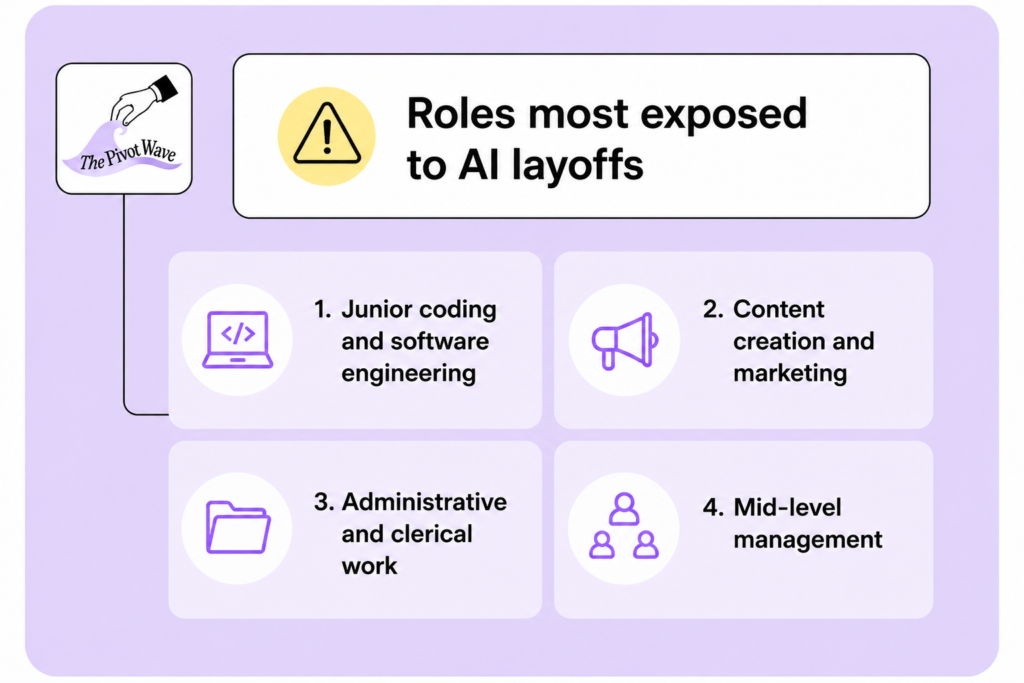
Customer support and service is the most heavily affected category by volume. Block, Klarna, Salesforce, eBay, and others have all reduced support headcount as AI systems handle an increasing share of routine queries. The vulnerable end of this category is high-volume, scripted work. Complex escalations, high-value customer interactions, and emotionally sensitive issues are holding — for now.
Junior coding and software engineering is the category getting the most attention. When Freshworks CEO Dennis Woodside told Reuters in May 2026 that more than half of the company's code is now written by AI, it crystallised something many developers had been watching quietly for months. New software engineering job postings declined 15% in the first two months of 2026 versus the same period in 2025, per LinkedIn data. The work isn't gone — but a team of ten developers with AI tools can produce the output of fifteen without them, and companies are doing the maths.
Content creation and marketing is the second most affected category. As generative models have improved, companies have reduced headcount in roles focused on writing, editing, and routine creative production. This doesn't mean all content work is at risk — original research, relationship-driven content, and work requiring genuine subject expertise are holding better — but bulk content production roles have been hit hard.
Administrative and clerical work is showing compression rather than sudden collapse. The World Economic Forum's 2025 Future of Jobs Report identified clerical and secretarial workers — administrative assistants, data entry clerks, bank tellers, payroll clerks — as the category facing the largest absolute decline through 2030. Baker McKenzie's cuts, which targeted research, marketing, and secretarial functions while largely protecting lawyers, fit this pattern.
Mid-level management is getting hit by a different mechanism: AI is compressing the number of coordination layers companies need. Amazon's explicit framing of its 2025 cuts as "flattening management layers" is part of this. When AI handles scheduling, reporting, and information routing, fewer managers are required to move information between teams.
The "AI washing" problem
The honest version of this story includes a significant caveat: not all of these cuts are what they're claimed to be.
Wharton professor Peter Cappelli told CNBC that there is "very little evidence" that AI eliminates jobs on the scale companies sometimes claim. Cognizant's Chief AI Officer Babak Hodjat said it would take more than a year before companies start seeing real productivity gains from AI — and that AI would often become "the scapegoat from a financial perspective, like when a company hired too many, or they want to resize."
The 2020–2022 hiring boom left many large tech companies significantly overstaffed relative to their actual revenue needs. The layoffs of 2023–2026 are in part the correction for that bubble. AI is the most PR-friendly explanation available — it positions the company as forward-thinking rather than reactive, and it tends to be received better by investors than "we hired too many people when money was cheap."
That said, the AI washing critique doesn't fully explain what's happening at Block, Klarna, Freshworks, or Atlassian — companies that cited specific AI systems replacing specific functions, not vague efficiency goals.
The real picture is a mix: genuine displacement in customer support and routine coding, headcount correction dressed as AI strategy in some large enterprises, and a harder-to-measure category of roles that haven't been formally cut but are slowly contracting through attrition as AI takes on more of the actual work.
What the data says about the longer view
The World Economic Forum's 2025 Future of Jobs Report — based on surveys of employers representing 14 million workers across 55 economies — projects 92 million jobs displaced and 170 million created over 2025–2030. A net gain of 78 million roles, in theory. The roles growing fastest are in AI development, cybersecurity, and sustainability.
Goldman Sachs estimates AI will displace roughly 6–7% of the US workforce — around 11 million workers — over the longer term, while creating jobs in the data centre and power infrastructure required to run the AI systems.
The gap between the exposure numbers (40–60% of tasks in office and administrative work are potentially automatable, per US Bureau of Labor Statistics data) and the actual layoff numbers (AI cited for about 21% of announced US job cuts through September 2026, per Challenger) is the central number in this debate. Exposure is not displacement. Tasks get automated before roles do, and roles contract before they disappear.
The jobs at most risk right now are the ones where the core output is routine, rule-based, or high-volume: scripted customer service, bulk content production, data entry, junior coding tasks, and basic financial processing. The jobs holding best are those requiring physical presence, embodied skill, human trust, or genuine domain expertise that can't be compressed into a prompt.
What to do if you're in an exposed role
The uncomfortable reality is that being in an exposed role doesn't mean you're about to lose your job — but it does mean the trajectory of your role is worth paying attention to now, not in two years.
A few things are worth doing regardless of where you sit:
Find out what your role actually produces. Not your job title — the specific outputs your team generates. Which of those outputs involve tasks AI is already doing elsewhere? Which require judgment, relationships, or context that's genuinely hard to compress? That analysis is more useful than any industry-level statistic.
Get measurably better at working with AI tools. This isn't about certification collecting. It's about being the person who can do the work of 1.5 people using AI tools, rather than the person whose output gets compared unfavourably to what a tool can produce. The AI Literacy Test is a useful starting point for benchmarking where you actually are.
Move toward the harder-to-automate end of your field. Customer service is being automated at the routine end — escalation handling, VIP relationships, and complex problem resolution are not. Content production is being automated at the bulk end — research, original reporting, and expert-backed writing are holding. The same gradient exists in most exposed fields.
Don't wait for your company to tell you what's happening. Amazon, Meta, and Accenture all communicated the AI-driven cuts after the decisions were made. The signals — AI tooling investment, productivity metrics being redefined, support functions being "reviewed" — were visible before the announcements.
Frequently asked questions
How many jobs has AI actually eliminated in 2025 and 2026?
Directly attributed by companies: around 55,000 in 2025 and 120,136 through September 2026, per Challenger, Gray & Christmas, which is more than double last year's total in nine months. Total tech layoffs, including cuts where AI was a contributing factor but not the stated cause, were much higher: nearly 246,000 in 2025 (per TrueUp) and 191,518 by early October 2026. On Layoffs.fyi's stricter count, 2026 passed its full-year 2025 total in the first week of August.
Is the AI layoff wave mostly a tech sector problem?
It started there, but it's spreading. The 2025–2026 wave included financial services (Citigroup, BlackRock), logistics (UPS, C.H. Robinson), legal (Baker McKenzie), consulting (Accenture), and education technology (Chegg). Over 60% of announced AI-related layoffs occurred at companies with more than 100,000 employees — but the cuts span industries.
Which roles are safest from AI-related displacement right now?
Roles requiring physical presence, embodied skill, or deep human trust: nurses, surgeons, therapists, electricians, plumbers, and trades workers. Among knowledge worker roles, those that combine genuine domain expertise with judgment, relationships, and context are holding better than high-volume, routine-output roles. No role is categorically safe, but the exposure varies enormously within the same industry.
Are companies being honest when they blame layoffs on AI?
Partially. OpenAI's Sam Altman called out AI washing directly — and data from the 2020–2022 hiring bubble supports the view that some of these cuts would have happened regardless of AI. But the cases where specific AI systems replaced specific functions (Block's customer service, Klarna's support agents, Freshworks' coding output) are documented and verifiable. Both are real; the proportion varies by company.
What should I do if I work in customer support, content, or junior development?
Don't panic, and don't wait. Customer support is being automated at the scripted, high-volume end — not the complex end. Content is being automated at the bulk end — not the expert-research end. Junior coding tasks are being picked up by AI — but developers who can direct, review, and extend AI-generated code are in demand. The practical move in all three cases is the same: get measurably skilled at using AI tools in your field, and position yourself toward the harder-to-automate work within it. The AI Readiness Assessment is worth taking to understand specifically how exposed your current role is.
The bottom line
The AI layoff wave is real, and it's accelerating. Amazon, Meta, Block, Atlassian, Accenture, and dozens of other companies have cut tens of thousands of jobs in 2025 and 2026, with AI cited as a direct factor. The roles most affected — customer support, junior coding, content, administrative work — are also the roles where AI has made the most measurable productivity gains.
But the picture is murkier than the headlines suggest. A meaningful share of these cuts are post-pandemic headcount corrections wrapped in AI-era language, and since August the wrapping itself has changed: Zillow, Etsy, LinkedIn, Microsoft, Uber and HubSpot all said publicly that AI wasn't the reason for their cuts, and AI fell from first to fifth in Challenger's monthly ranking of layoff reasons.