

How long does it take to hire in 2026?
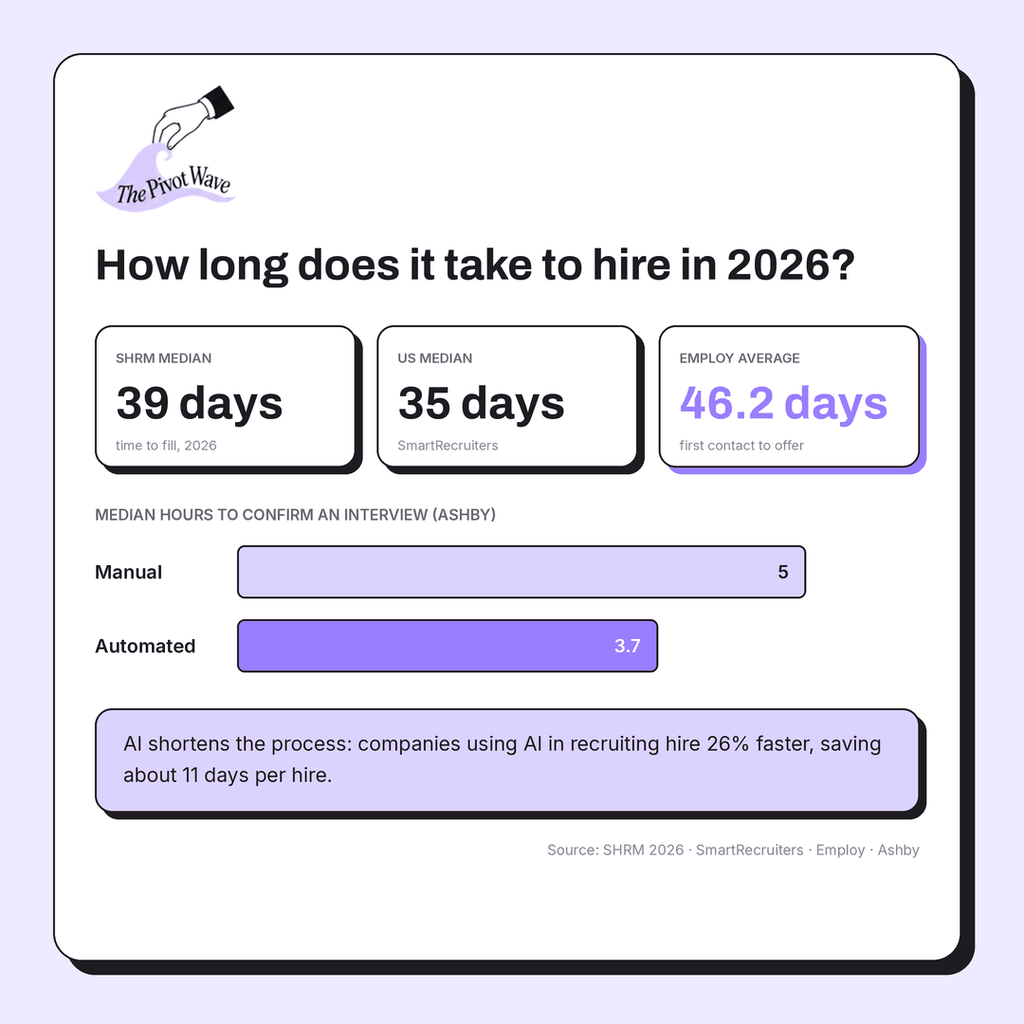
Most employers take 35–46 days.
SHRM puts the median time to fill a nonexecutive role at 39 days, SmartRecruiters measures a 35-day median in the US, and Employ shows 46.2 days from a candidate’s first contact to an accepted offer, or 63.5 days from the day the job was posted. Technical, IT and financial services roles take 50–63 days, retail employers about 25 days. For job seekers, the whole search from first application to first offer took a median of 82 days in Q2 2026 (Huntr).
Time to hire is one of the most quoted recruiting numbers. In 2025 and 2026, SHRM, Gem, Employ, Ashby, Greenhouse and SmartRecruiters have all published new data, with figures that range from 35 days to more than two months.
That gap is mostly about definitions, not data quality. So below, every figure comes with its source, its year and what exactly it measures, and each report is linked the first time it appears. I’ve kept this to figures I could trace to the original report; where the newest edition of a report is gated, I say so. The stats will be useful if you’re benchmarking a hiring process, planning headcount, or trying to figure out how long your own job search should take.
Time to hire statistics: the highlights
- The median time to fill a nonexecutive role dropped to 39 days in 2026, down from 44 days in 2025 (SHRM, 4,600+ organizations).
- Executive roles take a median of 45 days to fill, down from 60 days in 2022 (SHRM).
- The US median time to hire is 35 days, against a global median of 38 days (SmartRecruiters, 89 million applications).
- Employers on Employ’s platform took an average of 46.2 days from first candidate contact to accepted offer in 2025, and 63.5 days from job posting to accepted offer (Employ).
- Average time to hire rose 24% between 2021 and 2024, from 33 to 41 days, as companies ran 42% more interviews per hire (Gem, 2024 data).
- 60% of companies say their time to hire increased in 2025, and only 1 in 9 managed to hire faster (GoodTime, 500+ US talent leaders at companies with 1,000+ employees).
- IT and information security roles are the slowest to hire at 58 days, up 23 days since 2021 (Gem, 2024 data).
- Companies using AI in recruiting hire 26% faster, saving about 11 days per hire (SmartRecruiters).
- For job seekers, the median time from starting a search to a first offer was 82 days in Q2 2026, down from a record 108 days in Q1 (Huntr).
Time to hire vs time to fill
Time to hire and time to fill are often used as synonyms, but they measure different periods, and that’s where most of the confusion comes from.
Time to fill counts the days from the moment a role opens (the requisition is approved, or the job is posted) to the day a candidate accepts the offer. SHRM uses calendar days from requisition opening to offer acceptance, including weekends and holidays.
Time to hire starts later, when the person you eventually hire applies or is sourced, and ends at offer acceptance. It measures how fast your process moves a candidate, not how long the seat stays empty.
Employ reports both on the same dataset, which shows the gap clearly: 46.2 days of time to hire against 63.5 days of time to fill in 2025. That 17-day difference is the time a job sits open before the eventual hire even shows up. Two more things to check before you compare yourself: whether the benchmark is a median or an average (a few roles open for six months drag averages up, which is why SHRM reports medians), and whether it starts and stops counting at the same points you do.
| Benchmark | Days | What it measures | Source |
|---|---|---|---|
| SHRM, nonexecutive roles | 39 (median) | Requisition opened → offer accepted | SHRM 2026 |
| SHRM, executive roles | 45 (median) | Requisition opened → offer accepted | SHRM 2025, unchanged in 2026 |
| SmartRecruiters, US | 35 (median) | Time to hire, start point not published | SmartRecruiters, data Sept 2023–Aug 2024 |
| SmartRecruiters, global | 38 (median) | Time to hire, start point not published | SmartRecruiters, data Sept 2023–Aug 2024 |
| Gem | 41 (average) | Candidate enters ATS → hire | Gem 2025 report (2024 data) |
| Employ | 46.2 (average) | Candidate’s first interaction → offer accepted | Employ 2026 report (2025 data) |
| Employ | 63.5 (average) | Job posted → offer accepted | Employ 2026 report (2025 data) |
| Ashby | 60–75 (median) | Job opened → first hire | Ashby, May 2026 (data Jan 2021–Mar 2026) |
👉 Key takeaway: If you need one number, about 40 days covers most nonexecutive hires measured from requisition to acceptance.
Average time to hire in 2026
The headline survey number is going down. In SHRM’s 2026 Recruiting Executives Benchmarking, built on data from more than 4,600 organizations and published in June 2026, the median time to fill for nonexecutive positions fell to 39 calendar days, from 44 days in 2025. Executive time to fill stayed at 45 days. That’s a big change from 2022, when executive roles took a median of 60 days and the gap between executive and nonexecutive hiring was 16 days.
Size matters a lot here. In SHRM’s 2025 data, extra-large organizations (5,000+ employees) took 61 days to fill nonexecutive roles, roughly 17 days longer than that year’s median. They also spend nearly twice as long getting positions approved, getting jobs posted and running interviews.
SmartRecruiters’ platform data lands in the same range. Across 1.5 million jobs in 95 countries (September 2023 to August 2024, the most recent window it has published), the global median time to hire was 38 days. US hiring teams were 8% faster than that, at 35 days.
One caution on SHRM’s number: it reflects what HR leaders report in a survey, and the platform data in the next section tells a less flattering story.
Is hiring getting faster or slower?
The sources split here. HR leaders in surveys report faster hiring, while the systems that log every requisition mostly show the opposite.
On the platform side, Gem’s 2025 Recruiting Benchmarks, covering January 2021 to December 2024, found that the average time to hire rose from 33 days in 2021 to 41 days in 2024, a 24% increase. Greenhouse’s Hire Standard report, covering 640 million applications from 6,000+ companies, shows time to fill climbing every year from 43.64 in 2022 to 59.67 in 2025, a 37% rise (Greenhouse doesn’t state the unit on its public page, but the figures read as days).
GoodTime’s 2026 Hiring Insights Report, a survey of more than 500 US talent acquisition leaders at companies with 1,000+ employees, points the same way: 60% of organizations saw their time to hire increase in 2025, and only 1 in 9 managed to hire faster. Ninety percent of companies missed their hiring goals, and one in three missed them by a wide margin.
The one platform exception is Employ, where the average time to fill dipped from 67.7 days in 2024 to 63.5 days in 2025. Even there, time to hire inched up from 45.7 to 46.2 days.
👉 Key takeaway: The lower SHRM median is real, but most of the system data says the typical process is longer than it was before 2022, so we’d plan around the longer number.
Why hiring takes longer than it used to
None of the reasons in the data is a lack of candidates. The candidate pool isn’t the bottleneck; the process is.
- More interviews per hire. Gem counted 20 interviews per hire in 2024 against 14 in 2021, a 42% increase. Its 2026 report, which extends the data to May 2025, puts the rise since 2021 at 33%.
- Far more applications per role. Greenhouse saw applications per job more than double, from 116 in 2022 to 244 in 2025. Employ recorded 257.6 applications per job in 2025, about 50 more than a year earlier.
- Fewer recruiters. Greenhouse’s average recruiters per organization fell from 10.43 to 4.62 between 2022 and 2025, and Gem’s 2026 report says recruiters now handle 93% more applications than in 2021.
On top of that, GoodTime found recruiters spend 38% of their time scheduling interviews, the largest single operational cost it measured.
Average time to hire by industry
The table below combines the latest industry figures from Gem (2024 averages) and SmartRecruiters (2023–24 medians).
| Industry | Days to hire | Statistic | Source |
|---|---|---|---|
| Financial services | 63 | Average, 2024 | Gem |
| Manufacturing | 55 | Median, 2023–24 | SmartRecruiters |
| Manufacturing | 36 | Average, 2024 | Gem |
| Technology | 48 | Median, 2023–24 | SmartRecruiters |
| IT services | 48 | Average, 2024 | Gem |
| Healthcare | 41 | Median, 2023–24 | SmartRecruiters |
| Hospitality | 39 | Median, 2023–24 | SmartRecruiters |
| Computer software | 37 | Average, 2024 | Gem |
| Life sciences | 37 | Average, 2024 | Gem |
| Retail | 25 | Median, 2023–24 | SmartRecruiters |
Financial services is the slowest industry in Gem’s data at 63 days, 12 days longer than in 2021. Retail is the fastest in SmartRecruiters’ data at 25 days, 34% faster than the global median. Manufacturing shows why you shouldn’t mix sources: Gem’s customers hired manufacturing roles in 36 days on average, while SmartRecruiters’ median is 55 days. The two platforms simply serve very different employers. Note that SmartRecruiters classifies by the employer’s industry, not the role, so “retail” covers everything from shop floor to head office.
Healthcare and nursing
General healthcare roles hire in about six weeks (41 days, SmartRecruiters), but clinical roles take far longer. The 2026 NSI National Health Care Retention and RN Staffing Report, based on 527 US hospitals, found it takes an average of 78 days to recruit an experienced registered nurse. That’s five days faster than a year earlier, but still more than two and a half months. Telemetry nurses are the hardest to recruit at 87 days, and ER nurses the fastest at 70 days. Depending on specialty, the range runs from 56 to 102 days.
Time to hire by job function
The type of role swings the number by a month or more, even inside one company. Gem’s 2025 report breaks average time to hire down by department for 2024. Gem’s 2026 edition (data to May 2025) also publishes department cuts, but as medians inside a gated PDF, so the 2024 averages below are the latest department-level figures I could verify against the report itself.
| Department | Average days to hire (2024) | Change since 2021 |
|---|---|---|
| IT and information security | 58 | +23 days |
| Engineering | 53 | +3 days |
| Design | 53 | +4 days |
| Product management | 47 | –2 days |
| Legal and compliance | 47 | +2 days |
| Data science | 43 | –5 days |
| Business and strategy | 42 | +1 day |
| Marketing | 39 | No change |
| Customer success | 37 | –6 days |
| People and HR | 36 | +1 day |
| Finance | 36 | –1 day |
| Sales | 35 | +1 day |
| Customer service and support | 26 | +4 days |
| Operations | 25 | –1 day |
Technical roles are slow partly because of interview load. In Gem’s data, product management hires took 42 interviews per hire in 2024, and engineering and data science 39. Customer service roles needed just 9.
Ashby’s 2026 Recruiting Operations Benchmarks, built on 54 million applications and 93,000 jobs between January 2021 and March 2026, shows the same split, counting from the day the job opens. Technical roles take a median of 75 days from job opening to first hire, against 60 days for business roles. The interview loop alone (first to last interview) takes a median of 17.9 days for technical hires and 14.4 days for business hires. If you’re hiring engineers or security people, budget close to two months; if you’re moving into tech from another field, expect a longer interview loop than anything you’ve seen in sales or operations.
Time to hire by seniority
In Ashby’s data, junior roles take a median of 52 days to first fill, mid-level roles 63 days and senior roles 71 days, which makes senior hiring 37% slower than junior hiring, or about three weeks on the same platform.
The top of the ladder is the exception. Executive hiring in SHRM’s survey data has held at the 45-day median described above since 2025, down from 60 days in 2022, but companies are paying more to get there. SHRM’s median executive cost per hire reached $15,000 in 2026, up from $10,600 in 2025 and $5,000 in 2017. The nonexecutive median barely moved, from $1,200 in 2025 to $1,300 in 2026.
Time to hire by company size
In Gem’s 2024 data, the smallest companies (1–249 employees) hired fastest at 34 days on average, while companies with 1,000–4,999 employees took 42 days and those with 5,000+ took 41 days. SHRM’s survey also shows extra-large organizations as the slowest, at 61 days for nonexecutive roles in 2025.
Employ’s numbers point the other way, and that’s worth knowing before you benchmark. Small and midsize companies on Employ took an average of 83.5 days from posting to accepted offer in 2025, against 51.7 days at enterprises. Different size bands, different customers and different start dates produce opposite conclusions, so compare yourself with companies your own size on the same platform where you can.
Time to hire by country
SmartRecruiters’ benchmarks compare five countries, measured by job location:
| Country | Median days to hire |
|---|---|
| Australia | 32 |
| United States | 35 |
| Global median | 38 |
| France | 39 |
| United Kingdom | 40 |
| Germany | 55 |
Australia and the US hire 16% and 8% faster than the global median. Germany takes nearly two months, partly because works councils (Betriebsrat) are involved in hiring decisions.
Where the days go in a hiring process
Most of the delay happens after the first interview, not before it. SmartRecruiters’ global medians show a first review at around day 6, a first interview by day 14 and a hire at day 38. That leaves roughly 24 of the 38 days between the first interview and the hire.
SHRM’s 2025 data brief breaks time to fill into seven stages, from approval through posting, screening, interviews, decision and offer acceptance, and the stages where extra-large companies lose the most time are approval, posting and interviews. Ashby’s analysis lands on a similar conclusion: there’s rarely one bottleneck, and the gap between the fastest and slowest companies is spread across application review, scheduling, feedback and offer approval. Offer turnaround showed the biggest gap of any single stage, with the slowest quartile of companies taking 3.3 extra days for business roles and 4.7 for technical roles.
Candidates see the same pattern from their side. In Huntr’s Q2 2026 data, the median time from application to interview was 6 days, and from interview to offer 10 days. So if you want to cut time to hire, look at what happens after the interviews: how fast feedback comes in, how many people need to approve an offer, and how long it takes to send it.
How AI and automation affect time to hire
The best evidence on AI comes from platform data rather than vendor surveys. SmartRecruiters found that companies using its AI features hire 26% faster than those that don’t, saving about 11 days per hire. Ashby measured a more specific effect: interviews booked with automated scheduling are confirmed in a median of 3.7 hours, against 5 hours for manual scheduling, also 26% faster. That gain compounds across every interview round, but note where it lands: scheduling and screening, not the post-interview decision stage where most of the time goes.
Adoption is close to universal. GoodTime reports that 99.8% of talent acquisition teams use, pilot or plan to use AI agents. Teams using automated or AI-driven interview scheduling were 1.6 times more likely to reach near-perfect hiring goal attainment. GoodTime sells scheduling software, so treat that last figure as directional.
There’s a catch for job seekers. GoodTime’s respondents named fraudulent or AI-assisted candidates as the number one anticipated hiring challenge for 2026, ahead of a lack of qualified talent. Expect more verification steps, not fewer, which can lengthen the process for everyone. If you’re applying now, it’s worth knowing which AI job search tools actually help and which ones make you look like spam.
What time to hire means for job seekers
Employer time to hire covers one job. Your job search covers dozens of them, which is why it always feels longer than the benchmarks.
Huntr tracks this from the candidate side. Among its users with a recorded offer, the median time from starting a search to a first offer was 82 days in Q2 2026. That was the first quarterly drop in its series, down 24% from a record 108 days in Q1 2026. For comparison, the median was 58 days in Q1 2025, so the job search has still stretched by more than three weeks in 15 months.
The 6-day and 10-day medians above also give you a practical rule for follow-ups: silence for two weeks after an interview is normal; silence for a month usually isn’t. Plan for three months from your first application to your first offer, and longer if you’re targeting technical or senior roles. For a breakdown by field, see our data on how long it takes to find a job in marketing and tech, and if you’re worried your current role is exposed, our free Layoff Risk Assessment helps you decide how early to start.
How to calculate time to hire
Both formulas take one line each, and they only work as benchmarks if you apply the same start and end dates to every role.
Time to hire = date the candidate accepted the offer – date the candidate applied (or was sourced)
Time to fill = date the candidate accepted the offer – date the requisition was opened (or the job was posted)
If a candidate applied on day 15 after the job opened and accepted on day 40, the time to hire is 25 days and the time to fill is 40 days. To get your benchmark, calculate this for every hire in a period and report the median alongside the average. SHRM switched to medians precisely because a few outlier roles distort the average.
Frequently asked questions
What is the average time to hire in 2026?
Most current benchmarks put it between 35 and 46 days, depending on whether counting starts at the requisition (SHRM, 39-day median) or at the candidate’s application (SmartRecruiters, 35-day US median; Employ, 46.2-day average).
What is a good time to hire?
A good time to hire beats the median for your role type and industry, measured the same way as the benchmark. For most nonexecutive roles, that means under 39 days from requisition to acceptance. For technical roles, Gem’s 53-day engineering average is a fairer comparison than an all-roles number.
Which industry has the longest time to hire?
Among current data, financial services is the slowest at an average of 63 days (Gem, 2024), and hospital nursing takes even longer, at 78 days to recruit an experienced RN (NSI, 2026). Retail is the fastest at a 25-day median (SmartRecruiters).
Why does hiring take so long?
Companies interview more (Gem counts 42% more interviews per hire than in 2021), applications per job have more than doubled since 2022 (Greenhouse) while recruiting teams have shrunk, and recruiters spend 38% of their time scheduling interviews (GoodTime).
Is the 44-day time to hire figure still accurate?
It’s outdated. The 44-day figure comes from Josh Bersin Company and AMS research published in June 2023, and SHRM’s own nonexecutive median was 44 days in 2025 before dropping to 39 days in 2026.
How long does it take to get a job offer after an interview?
A median of 10 days in Huntr’s Q2 2026 data. Employers also report that the stretch after the first interview is the slowest part of the process.
The bottom line
Every benchmark in this article points at the same stretch of the process: the weeks between the first interview and the signed offer. SmartRecruiters puts 24 of its 38 days there, Ashby finds the widest gap between fast and slow companies at offer turnaround, and candidates wait longer for an offer than for an interview. The AI tools companies have adopted almost universally mostly speed up what happens before that stretch. So if you’re an employer, the fastest win is not another screening tool but a decision deadline after the final interview and fewer signatures on the offer. If you’re a candidate, that same stretch is why a three-month search is normal in 2026, and why silence after an interview doesn’t mean no.
Sources
Benchmarks and surveys- SHRM – 2026 Recruiting Executives Benchmarking: Attracting Critical Talent (data brief, June 2026)
- SHRM – 2025 Recruiting Executives Benchmarking: Insights to Maximize Recruitment (PDF)
- SmartRecruiters – Recruiting Benchmarks 2025–2026 (PDF; data September 2023 to August 2024)
- GoodTime – 2026 Hiring Insights Report press release, January 2026
- Gem – 2025 Recruiting Benchmarks Report (PDF; data January 2021 to December 2024)
- Gem – Key takeaways from the 2026 Recruiting Benchmarks Report (data June 2021 to May 2025)
- HR Dive – Companies are hiring faster from a deeper talent pool (Employ 2026 Hiring Benchmarks Report)
- Greenhouse – The Hire Standard, March 2026
- Ashby – Recruiting Operations Benchmarks, 2026 Talent Trends Report, May 2026