

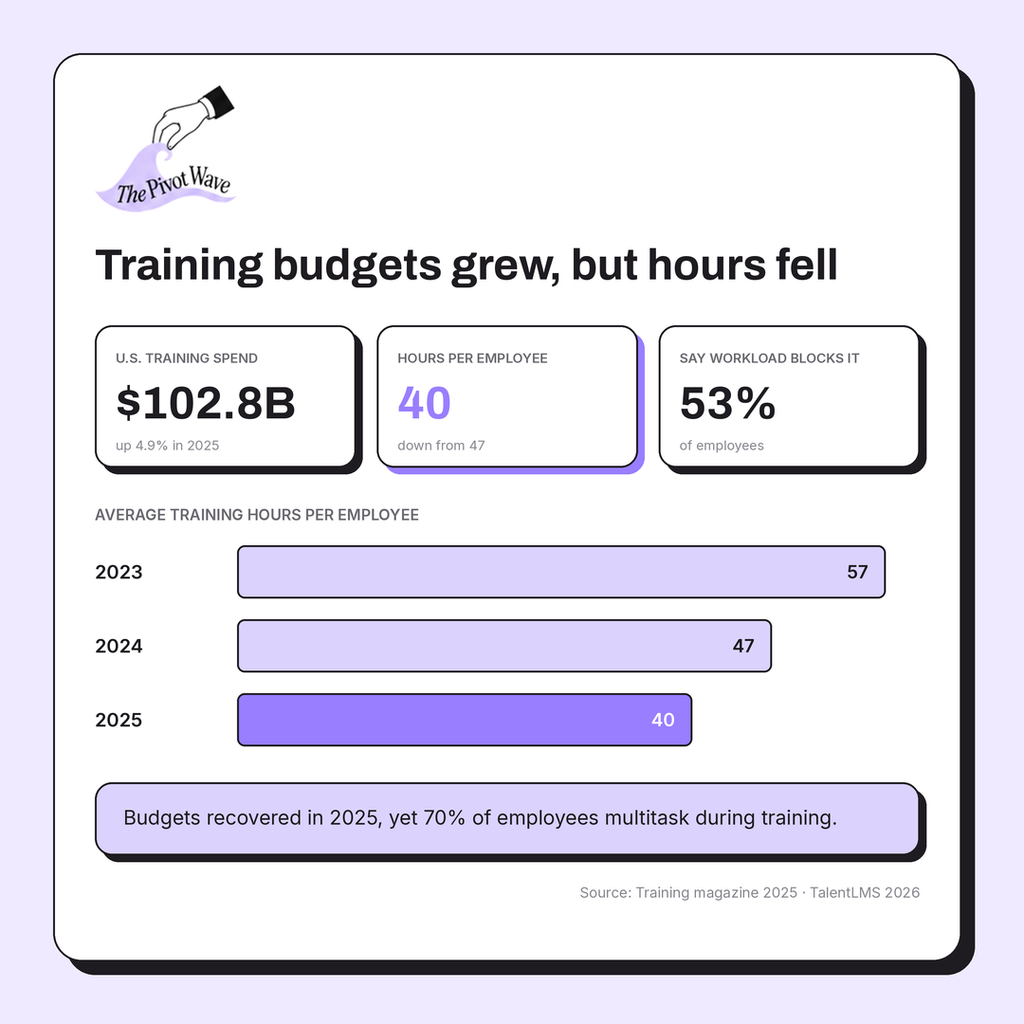
What does employee training look like currently? The most recent full-year data, from 2025, shows U.S. companies spent $102.8 billion on training in 2025, 4.9% more than the year before. Yet the average employee received 40 hours of training, down from 47, and half of employees say heavy workloads leave no room to learn.
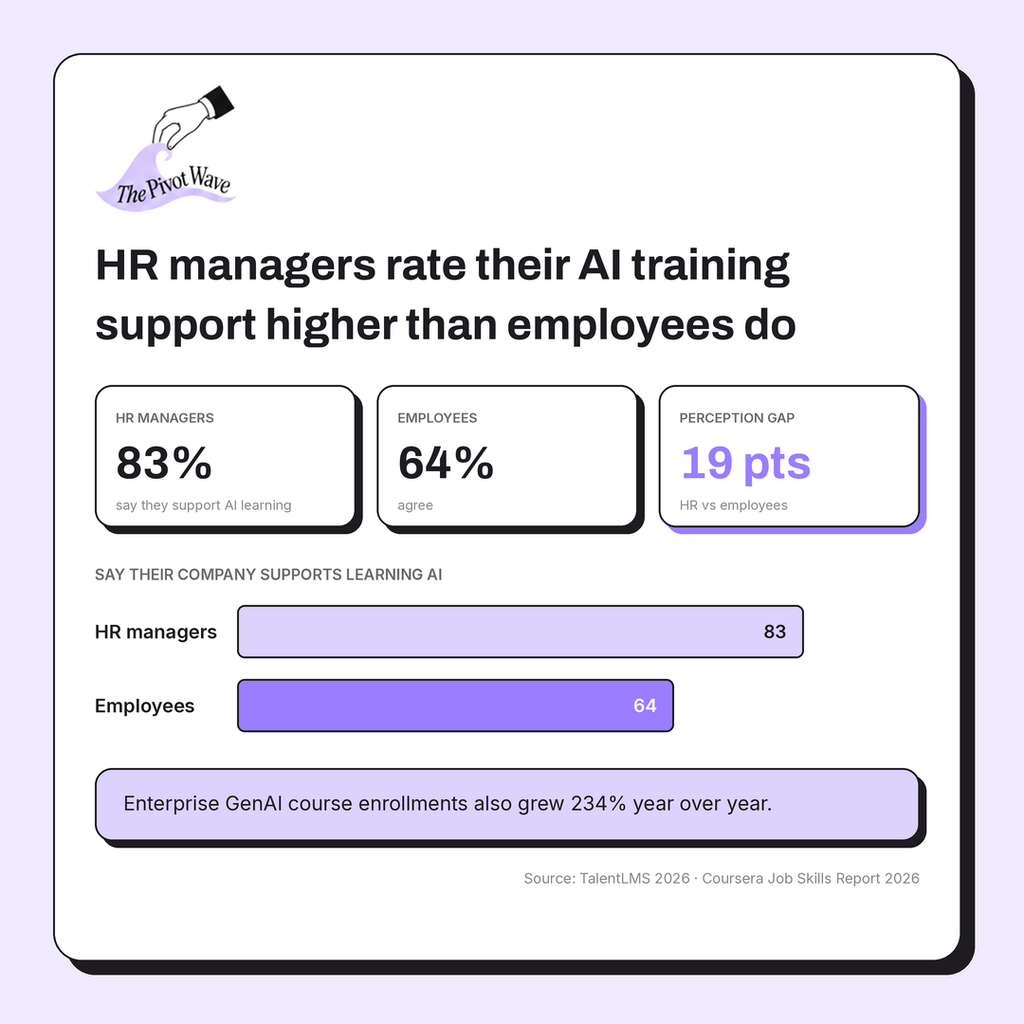
AI training is now the fastest-growing topic, yet only 64% of employees say their company helps them learn AI, compared with 83% of HR managers who believe it does.
Employee training has become an important part of keeping a business current and retaining employees who want to grow. Companies are spending more on training than ever, but employees are getting less time to learn, and nearly every recent study shows the same gap between budget and time.
Below are the employee training statistics worth knowing, grouped by topic, with the source linked for each figure. This information should be helpful both for HR professionals planning new initiatives and for employees who want to know what to expect from their employers.
Employee training statistics: the highlights
- U.S. training spend reached $102.8 billion in 2025, up 4.9% (Training magazine, 2025).
- The average employee received 40 hours of training in 2025, down from 47 in 2024 (Training magazine, 2025).
- Formal learning hours rose to 16.7 per employee, while direct learning spend per employee fell to $846 (ATD, 2025 data).
- 53% of employees say high workloads leave little room for training, and 70% multitask during training sessions (TalentLMS, 2026).
- 95% of HR managers say better training improves retention, and 35% of employees would leave if denied training (TalentLMS, 2026).
- Global employee engagement fell to 20%, and low engagement cost about $10 trillion, or 9% of global GDP (Gallup, 2026).
- 59 out of every 100 workers will need training by 2030 (World Economic Forum, 2025).
- Enterprise enrollments in generative AI courses grew 234% year over year (Coursera, 2026).
- Only 14% of companies qualify as “talent velocity” leaders that can see, build and move skills in time (LinkedIn, 2026).
How much do companies spend on employee training?
U.S. training expenditures rose 4.9% to $102.8 billion in 2025, according to Training magazine’s annual Training Industry Report. That recovers the 3.7% drop recorded a year earlier, when spending fell to $98 billion.
About 63% of that money goes on training staff: payroll grew by nearly 7% to $64.7 billion, and companies spent an average of $874 per learner, up from $774 in 2024. Per-learner spend runs opposite to company size: small companies spent $1,091 per learner, more than double the $468 at large corporations.
The Association for Talent Development (ATD) measures something narrower. Its 2026 State of the Industry report counts only direct learning spend (content, facilitators, platforms and materials) and found it fell to $846 per employee in 2025, down from $1,254 in 2024. The two reports measure different things, so they can move in opposite directions.
In TalentLMS‘s 2026 survey, 76% of HR managers said they were satisfied with their L&D budget, up from 61% in 2022, and the share of executives who see L&D as “a cost rather than an investment” fell from 54% to 41%.
How many hours of training do employees get?
Employees received an average of 40 hours of training in 2025, down from 47 in 2024 and 57 in 2023 (Training magazine). Services organizations delivered the most, at 51 hours per employee.
ATD tells a different story because it counts only formal, structured learning. Employees used 16.7 formal learning hours in 2025, up from 13.7 in 2024. The two reports aren’t contradicting each other: Training magazine covers all training at U.S. organizations with 100 or more employees, while ATD leaves out coaching and on-the-job learning.
| Measure | 2024 | 2025 | What it counts |
|---|---|---|---|
| Training hours per employee (Training magazine) | 47 | 40 | All training at U.S. companies with 100+ employees |
| Formal learning hours per employee (ATD) | 13.7 | 16.7 | Structured, formal learning only |
Time is still the main barrier for employees. In TalentLMS‘s 2026 survey, 53% of employees and 50% of HR managers said high workloads leave little room for training, even when it’s needed. Multitasking during training reached 70%, up from 58% a year earlier, and 65% of employees said performance expectations rose in the past year.
👉 Key takeaway: For a business case, quote Training magazine’s 40 hours for all training or ATD’s 16.7 hours for formal learning only, and name which one you’re using.
Does employee training improve retention?
In TalentLMS’s 2026 L&D Benchmark Report, which surveyed 1,000 U.S. employees and 101 HR managers in September 2025, 95% of HR managers agreed that better training and skill development improve retention. Employees see it the same way: 73% said stronger development opportunities would make them stay longer.
35% of employees said they’d look for another job if denied training in 2025, up from 2024.
Global employee engagement fell to 20% in 2025, down from a peak of 23% in 2022, the second annual decline in a row, according to Gallup. Gallup estimates that disengagement costs the global economy about $10 trillion in lost productivity, equal to 9% of global GDP.
Managers are driving most of the drop. Manager engagement fell nine points since 2022, including five points in 2025 alone, from 27% to 22%.
How is AI changing employee training?
AI is now both a training topic and a training tool. Enterprise enrollments in generative AI courses grew 234% year over year, according to Coursera’s Job Skills Report 2026, which draws on nearly six million enterprise learners across almost 7,000 organizations. On the delivery side, 71% of L&D professionals are exploring, experimenting with or integrating AI into their work (LinkedIn, 2025).
Most companies now offer some form of AI training. Only 6% of HR managers in the TalentLMS survey said their company doesn’t, and ATD found more companies provide practical AI skills training than technical AI training (55% versus 45%).
83% of HR managers say their company helps people learn AI, but only 64% of employees agree (TalentLMS). D2L’s 2025 survey of 996 U.S. employees found 58% feel left to learn AI on their own, and while 64% get AI tools from their employer, only 25% strongly agree there’s a clear vision for how to use them in their role.
Nearly half of HR managers (47%) said their AI training is designed, at least in part, to make jobs easier to automate, and 36% of employees said generative AI tools are weakening their ability to solve problems on their own.
How fast are workplace skills changing?
The World Economic Forum’s Future of Jobs Report 2025 expects 39% of workers’ core skills to change by 2030. That’s down from 44% in the 2023 edition, partly because more workers have already been trained: the share who completed training rose to 50% in 2025, from 41% in 2023.
If the global workforce were 100 people, 59 would need training by 2030. Employers expect to upskill 29 of them in their current roles and redeploy 19, and skills gaps are the biggest barrier to transformation for 63% of employers.
Satisfaction with workplace training reached 84% in 2025, up from 79% in 2024 and 75% in 2022, and 83% said they received enough training (TalentLMS). Most skill-building still happens on the job, though: 65% of employees named on-the-job experience as their main way to build skills, ahead of company training at 47%.
What do employees want from career development?
LinkedIn’s 2025 Workplace Learning Report found only 36% of organizations qualify as “career development champions” with mature programs. Another 31% run programs with limited adoption, and 33% have none or are just starting. The champions are 42% more likely than other organizations to be frontrunners in generative AI adoption.
LinkedIn’s 2026 follow-up, the Talent Velocity Report, finds an even smaller leading group. 86% of companies lack the ability to see their skills, build what’s needed and move people in time, and only 14% qualify as leaders.
Right Management’s November 2025 study of 2,402 employees in eight countries found 4 in 10 have no career plan at all, and only 4% have a documented one. Just 1 in 5 say their manager helps them map a career path, and only 35% know what development opportunities their company offers.
In the TalentLMS survey, 44% of HR managers said their company prioritizes external candidates over internal ones for new roles, even though 84% said their L&D programs are linked to career progression.
👉 Key takeaway: Only 35% of employees know what development their company already offers, so publicizing existing programs is a sensible first step before building new ones.
What the numbers mean for L&D teams
1. Protect time for learning
Half of employees say workloads crowd out training, and 70% multitask through it. Short, job-relevant formats and blocked learning time will do more than another course in the catalog.
2. Train the managers first
Gallup puts the engagement decline on managers, and only 1 in 5 employees say their manager helps with career planning. Start manager training with career conversations, since that’s where employees say help is missing.
3. Ask employees what AI training they actually got
When 83% of HR managers say they support AI learning but only 64% of employees agree, the first step is a short survey of what people received and what they still can’t do, before buying more licenses.
For the wider picture, see our data on AI and the job market, online learning statistics and job satisfaction statistics.
Employee training FAQ
How much do U.S. companies spend on employee training?
$102.8 billion in 2025, up 4.9% from $98 billion in 2024, according to Training magazine. That works out to an average of $874 per learner.
How many hours of training does the average employee get?
40 hours in 2025, down from 47 in 2024 (Training magazine). ATD counts formal learning only and puts it at 16.7 hours in 2025, up from 13.7.
How often should employees be trained?
Most companies now train at least quarterly. In TalentLMS‘s 2026 survey, 42% of HR managers said formal training happens quarterly, 32% monthly and 13% weekly, so nearly nine in ten train at least once a quarter.
Does training improve employee retention?
95% of HR managers say it does, 73% of employees say better development would make them stay longer, and 35% say they’d leave if denied training (TalentLMS, 2026).
What is the 70-20-10 model?
It’s a rule of thumb that about 70% of learning happens on the job, 20% through other people such as managers and mentors, and 10% through formal training. It’s a framework rather than a measured finding, but recent data points the same way: 65% of employees say on-the-job experience is their top way to build skills (TalentLMS, 2026).
Which KPIs should you track for training?
Completion and satisfaction are the easiest to collect, but they don’t show impact. Pair them with skill assessment scores, time to productivity, internal mobility and retention. Only 37% of HR managers measure L&D by business impact (TalentLMS, 2026).
Employee training in 2026: the bottom line
Budgets aren’t the constraint in 2026: U.S. spend is at a record high and 84% of employees are satisfied with their training. The weak points are time, with half of employees saying workloads crowd out learning, and AI training, where HR is far more confident than employees that support exists.
Sources
Training spend and hours- Training Magazine – 2025 Training Industry Report
- Training Magazine – 2024 Training Industry Report
- ATD – Highlights from the 2026 State of the Industry Report
- ATD – 2026 State of the Industry Report Indicates Latest TD Trends
- TalentLMS – 2026 Annual L&D Benchmark Report
- Gallup – State of the Global Workplace, 2026 press release