

DataCamp vs Codecademy comes down to one question: are you learning to work in data and AI, or learning to code broadly? DataCamp is built end-to-end for data science, analytics, and AI, and in 2026 its AI catalog goes deep enough to take you to production. Codecademy is the generalist — web, mobile, cybersecurity, cloud, plus the best technical-interview prep of the two. Codecademy Plus is the cheaper entry point; DataCamp wins decisively on AI depth. The subject-fit gap matters far more than the price gap.
DataCamp vs Codecademy: which one should you actually pay for in 2026? Pick DataCamp if your goal is data, analytics, or AI: it has 580+ courses, a deep AI track that covers generative AI, agentic systems, and AI engineering, plus industry-recognized certifications. Pick Codecademy if you want broader programming coverage (web, mobile, cloud, cybersecurity) and you care about technical interview prep. On price, Codecademy Plus is cheaper at $14.99/month billed annually; DataCamp Premium runs $13 to $43/month depending on promotions and billing cycle. Codecademy’s AI catalog is still mostly introductory. DataCamp wins on AI depth, full stop.
DataCamp vs Codecademy: the short answer
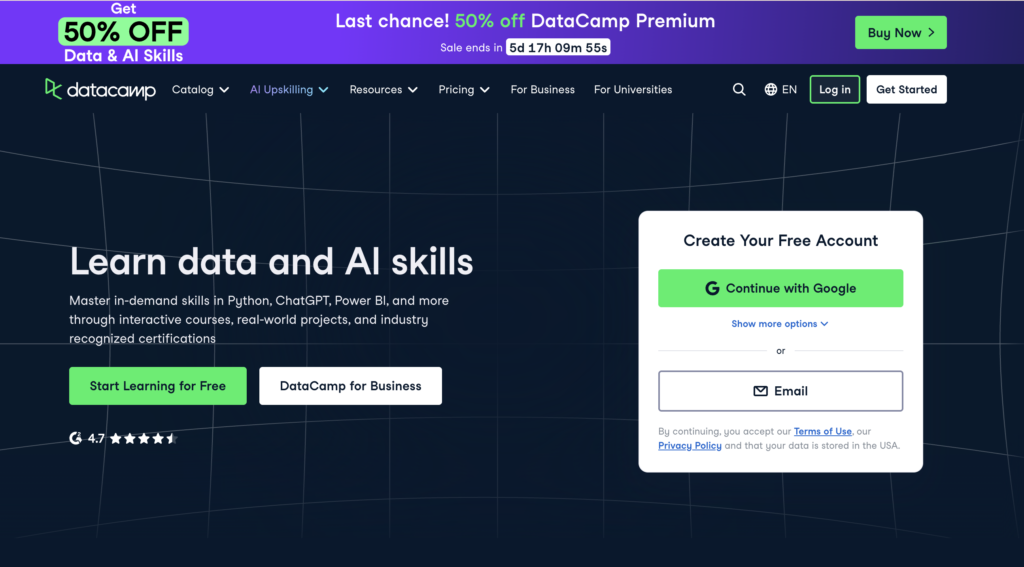
Choose DataCamp if you:
- Want to learn data science, analytics, or AI as your main goal
- Prefer hands-on, in-browser coding from lesson one with no setup
- Need industry-recognized certifications in Python, SQL, Power BI, Tableau, or AI engineering
- Plan to build a portfolio using DataLab (their AI-assisted notebook)
- Care about staying current with generative AI, RAG, and agentic workflows
Choose Codecademy if you:
- Want to explore programming broadly: web dev, mobile, cybersecurity, DevOps, cloud
- Are preparing for a technical interview at a tech company (Pro includes interview simulator + code challenges)
- Prefer self-paced text + code without watching video lectures
- Need a cheaper entry point at $14.99/month annual billing
- Want professional certifications for software engineering or front-end paths
Head-to-head comparison
| Feature | DataCamp | Codecademy |
|---|---|---|
| Founded | 2014 | 2011 |
| Course count | 727+ courses, 80+ projects | 300+ standalone courses, 60+ skill/career paths |
| Main focus | Data science, analytics, AI | General programming (web, mobile, data, cloud, cybersecurity) |
| Free plan | First chapter of every course free + free Basic tier | Basic tier (no quizzes or projects) |
| Cheapest paid plan | Premium: $14–$28/month billed annually (varies by promotion) | Plus: $14.99/month billed annually |
| Highest individual plan | Premium (single tier) | Pro: $19.99/month billed annually |
| Coding environment | Browser-based with instant feedback | Browser-based with auto-graded quizzes |
| AI assistant | Platform AI Assistant + DataLab AI for analysis | Unlimited AI learning assistance on Plus and Pro |
| Languages covered | 16 (Python, R, SQL, Scala, Julia, others) | 15+ (Python, JavaScript, Java, C++, SQL, Ruby, others) |
| AI/ML depth | Generative AI, agentic AI, AI engineering, RAG, fine-tuning | Intro-level generative AI, ML basics, cloud AI on Azure/GCP |
| Certifications | Career, Technology, and Fundamentals tiers (incl. Data Analyst, Data Scientist, AI Engineer) | Certificates of completion + Pro Professional Certifications (6 paths) |
| Career services | Job-readiness checker (Premium) | Interview simulator, technical interview prep, career paths (Pro only) |
| Mobile app | Yes | Yes (Codecademy Go) |
| Refund window | Not advertised | 7-day money-back |
| User base | 14 million learners | 50+ million learners |
| G2/Trustpilot rating | ~4.6/5 | ~4.4/5 |
Pros and cons: DataCamp
✅ Pros
- Largest data and AI catalog of any general-purpose learning platform
- Industry-recognized certifications designed with hiring-manager input, valid for two years
- DataLab, the integrated AI notebook, is genuinely useful for projects and portfolio work
- Active AI partnerships with Hugging Face, LlamaIndex, Microsoft, AWS, and KNIME
- Single Premium tier — no upsell maze, everything is in one price
- Strong mobile app with 5-minute daily challenges, rare among competitors
❌ Cons
- Pricing is opaque and swings with constant promos, which makes budgeting annoying
- Outside data and AI the catalog is thin: no serious web dev, no mobile, almost no general software engineering
- The fill-in-the-blank format limits how much you actually build from scratch
- Certificates of completion aren’t academically accredited
- No live instructor-led option for individual learners
Pros and cons: Codecademy
✅ Pros
- Broad programming catalog across 15+ languages and most major tech domains
- Pro includes the interview simulator and code challenges — useful for job seekers
- Cheaper entry point at $14.99/month annually for Plus
- 7-day free trial and a 7-day refund window on annual plans
- Live virtual bootcamps available for learners who want structure
- The free Intro to Generative AI course is a solid first taste of AI
❌ Cons
- AI and ML content is shallow next to DataCamp: no agentic AI, no AI engineering, no RAG deep dive
- Career features are gated behind Pro at $239.88/year
- Some learners report aggressive billing and difficulty cancelling — read the fine print
- Content quality varies more across the catalog than on DataCamp
- Professional Certifications are limited to 6 career paths
Pricing
Both platforms run aggressive seasonal sales, so the sticker price is rarely what people pay. Here’s the standard 2026 pricing, and the honest read underneath it.
| Plan | DataCamp | Codecademy |
|---|---|---|
| Free tier | Basic: first chapter of every course, limited library access | Basic: limited access, no quizzes or projects |
| Paid (annual) | Premium: $14–$28/month billed annually (regular pricing varies; promos drop it lower) | Plus: $14.99/month billed annually = $179.88/year |
| Paid (monthly) | Premium: $35/month | Plus: $29.99/month |
| Top individual | Premium (one tier) | Pro: $19.99/month annually = $239.88/year, or $39.99/month |
| Other options | DataLab (unlimited workbooks): $7-$13 per user /mo (billed annually) or $22billed monthly | |
| Teams | Teams: ~$14/user/month annually, plus Enterprise with SSO | Teams: $24.92/user/month annually |
| Bootcamps | None | $360-$480 |
Two things the pricing table won’t tell you. First, DataCamp’s Premium tier collapses everything — courses, projects, certifications, DataLab — into one subscription, so there’s no feature you unlock later. Codecademy splits its career features into Pro: if you only want courses, Plus is fine; if you want career paths, professional certifications, the interview simulator, and code challenges, you need Pro at $19.99/month annually.
Second, don’t pay sticker price on DataCamp. It discounts often, and Premium regularly lands near Codecademy Plus during a sale. For a fair mental model: Codecademy Plus is the budget option, and DataCamp Premium is roughly comparable to Codecademy Pro.
Teaching style: video-and-fill-in vs text-and-write
This is where the two platforms actually feel different, and you notice it in the first free lesson.
How DataCamp teaches you
You watch a 3–4 minute video where an instructor walks through a concept, then you drop into an exercise where some code is already written and the prompt tells you which line to edit: “use the mean() method on df['sales'] to find its average.” You fill in the blank, get instant feedback, earn XP, move on. For absolute beginners this lowers the activation cost — you’re not fighting syntax noise while you’re trying to grasp an idea — and the gamified streaks make daily practice stick.
The trade-off is well documented. The fill-in-the-blank format is easy to coast through:
“The exercises focused too much on syntax and knowing what function to fill in, and not enough on why you’d use it.” [verify quote — r/datascience]
DataCamp is excellent for learning the syntax and patterns of a specific data tool fast — pandas, dplyr, SQL, Tableau. It’s weaker if your goal is to build an app from a blank file.
How Codecademy teaches you
Codecademy is browser-based but text-first. You read a short lesson, write code in the panel, run it, see the output. Auto-graded quizzes and code challenges are spaced through every course, and Pro adds a technical-interview track with challenges modeled on real tech-company interviews plus an AI-powered interview simulator.
“Codecademy is the platform that taught me to code. The write-it-yourself format is why it stuck.” [verify quote — r/learnprogramming]
For JavaScript, React, full-stack web, mobile (Swift, Kotlin), cybersecurity foundations, or DevOps basics, Codecademy has the broader catalog and the more developer-flavored content.
The verdict on style: DataCamp is better for analysts learning to code. Codecademy is better for people becoming developers. Pick DataCamp if pre-filled scaffolding keeps you moving; pick Codecademy if writing the whole thing yourself is what makes it stick.
AI and data depth: where the two platforms split
This is the single biggest reason to pick one over the other in 2026. With AI reshaping the job market faster than any technology shift in the last decade, where you learn AI matters. If you are learning AI to work in AI, the gap between these two platforms is large.
DataCamp’s AI catalog
DataCamp restructured its entire curriculum around data and AI starting in 2024 and added 100+ new courses last year, most of them weighted toward AI and machine learning. The catalog now covers the full pipeline from beginner AI literacy to production AI engineering:
- AI Fundamentals: a free skill track covering ChatGPT, prompting, and the basics of how generative models work
- Generative AI Concepts: covers generative vs discriminative models, transformers, LLMs, prompt engineering, RAG, fine-tuning, and responsible AI
- AI Agent Fundamentals: a skill track introducing the Thought-Action-Observation (TAO) loop, ReAct prompting, multi-agent design patterns, and emerging protocols including Model Context Protocol (MCP) and Agent-to-Agent (A2A)
- Introduction to AI Agents: standalone course for hands-on agent building
- Associate AI Engineer for Developers: full 21-hour career track from prompt engineering to agentic systems
- AI Engineer for Data Scientists Associate certification, designed with an advisory panel of hiring managers, valid for two years
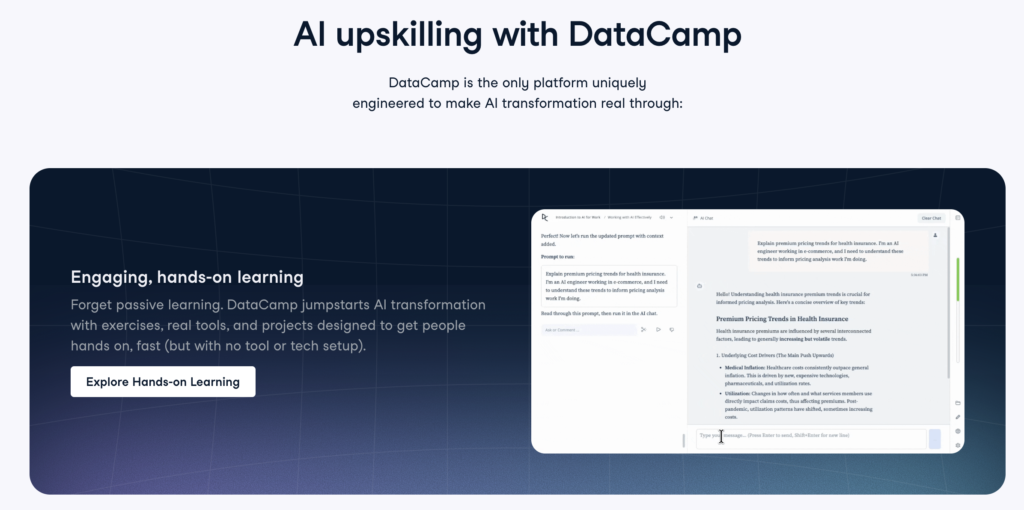
DataCamp also partners with Hugging Face and LlamaIndex on AI content, and has integrated partner-aligned certifications for Azure, AWS, and KNIME. The DataLab notebook environment includes an AI assistant that can generate code, fix errors, and let you “chat with your data”. That part genuinely accelerates learning if you already have some Python. If you want to see how DataCamp’s generative AI tracks stack up against other platforms, my roundup of the best generative AI courses and best agentic AI courses compares the strongest options.
One option worth knowing about is DataCamp’s AI upskilling platform, which is used by companies like Colgate-Palmolive, Bayer, and Pfizer to train employees on AI. DataCamp’s approach is hands-on — actual exercises and projects rather than videos you half-watch. The curriculum spans a pretty wide range: AI basics and prompt engineering for people just getting started, through to more technical tracks like generative AI engineering and LLMOps.
Codecademy’s AI catalog
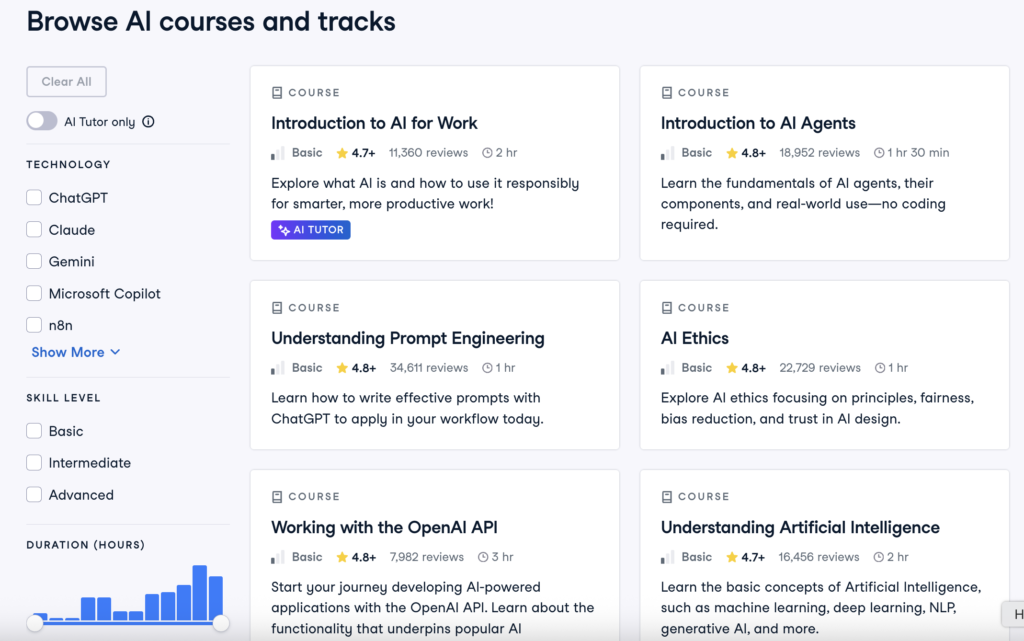
Codecademy added AI to its catalog more recently and the depth shows it. Most of the AI content sits at the introductory level. The notable courses are:
- Intro to Generative AI: free standalone course covering how generative models work, with interactive applets
- Introduction to Generative AI on Azure: partner course covering Azure OpenAI, Bot, and Machine Learning services
- Generative AI on GCP: An Introduction: covers the generative AI lifecycle, image generation, and NLP on Google Cloud
- Machine Learning catalog: covers core ML concepts, supervised/unsupervised learning, neural network basics
- AI Learning Assistant built into the platform on Plus and Pro
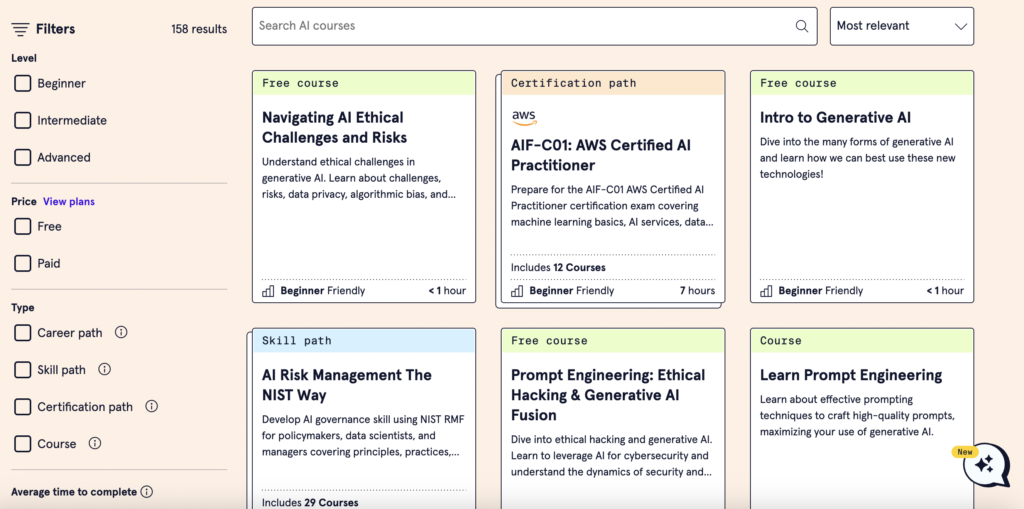
What’s missing: there is no Codecademy equivalent of DataCamp’s AI Engineer track, no agentic AI deep dive, no RAG or fine-tuning skill paths, and no AI-specific professional certification. The Data Scientist: Machine Learning Specialist career path is the closest thing, but it leans more “ML with Python” than “build AI applications.”
Bottom line on AI: if you want to enter the AI job market in 2026, DataCamp has the curriculum. Codecademy will teach you what generative AI is. DataCamp will teach you how to ship an agentic system to production. If you specifically want to build AI agents that automate workflows at your job, also look at my list of AI automation courses, which covers tools beyond pure coding tracks.
Curriculum by subject: who wins each area
Catalog size aside, the two platforms have genuinely different strengths once you break the curriculum down by topic.
- Data science, analytics, AI: DataCamp, decisively. It’s the entire point of the platform.
- SQL and R: DataCamp. Dedicated tracks and better-produced content; Codecademy covers SQL but not as deeply.
- Python: Roughly even for fundamentals. DataCamp leans data-Python (pandas, numpy); Codecademy leans general-purpose Python.
- Web development (HTML/CSS, JavaScript, React, full-stack): Codecademy, and it isn’t close — DataCamp barely touches this.
- Mobile (Swift, Kotlin): Codecademy. DataCamp doesn’t cover it.
- Cybersecurity, DevOps, cloud fundamentals: Codecademy has the broader catalog.
- Technical interview prep: Codecademy Pro — interview simulator + real-style code challenges. DataCamp has no equivalent.
- Machine learning engineering / production AI: DataCamp, by a wide margin.
Short version: DataCamp owns data and AI depth; Codecademy owns programming breadth and the path into a developer job. Your career goal decides the winner, not the feature list.
How long each path takes
Both platforms are fully self-paced, so the honest metric is total hours, not calendar weeks. Rough estimates using each provider’s own guidance:
| Track | DataCamp | Codecademy |
|---|---|---|
| Python fundamentals | ~15–25 hours | ~25–35 hours |
| Data Analyst path | ~60 hours | Data Analytics path ~70–90 hours |
| Full-stack / front-end web | Not offered | ~150–300+ hours (career path) |
| Data Scientist / ML | ~90–100 hours | ~100+ hours (ML specialist path) |
| Single skill track | 14–24 hours | Varies widely by path |
The pattern learners report: DataCamp’s hour counts look shorter because the exercises are lighter, so retention can be shallow unless you build your own project afterward. Codecademy’s write-it-yourself format takes longer per lesson but the code muscle sticks. In practice most people finishing a full track on either platform spend three to six months part-time.
Certificates and getting a job
For career changers, this is the whole game — and it’s the cluster people search hardest. Hiring managers treat both platforms’ certificates of completion as “nice context, not a credential.” DataCamp’s Career and Technology Certifications carry a bit more weight because the assessments are timed and built with hiring managers, and Codecademy Pro’s interview prep is a real advantage if you’re targeting tech-company loops. But on both platforms, what actually gets interviews is a portfolio: a GitHub repo with three to five solid projects you can talk through.
The practical move on either platform is the same — use the courses to learn the syntax and patterns, then build your own project on real data to prove you can. If you’re weighing DataCamp against the most job-outcome-focused data platform, our DataCamp vs Dataquest comparison covers the closest direct alternative, and what a data analyst actually does on day one shows the kind of work employers expect.
What users say (2026 reviews and Reddit)
Themes pulled from Trustpilot, G2, and Reddit threads in r/learnprogramming, r/datascience, and r/learnmachinelearning:
On DataCamp:
- Beginner data learners consistently praise the structure — “no prior coding experience and DataCamp made Python and SQL easy” is a recurring line [verify quote]
- Experienced data scientists call the exercises “too guided” and recommend supplementing with Kaggle or your own projects
- Trustpilot sits around 4.6/5 across thousands of reviews
- Common advice: use DataCamp to learn the syntax, then build a real project to actually retain it
On Codecademy:
- Long-standing strength is beginner-friendliness — “the platform that taught me to code” comes up often [verify quote]
- Pro is recommended specifically for interview prep at FAANG-tier companies
- Common complaint: “legit but pricey given freeCodeCamp exists for free”
- Multiple reports of difficulty cancelling subscriptions — check the billing terms before signing up
The honest takeaway: DataCamp’s fans are mostly career-changers entering analytics or data science; Codecademy’s fans are mostly people who landed a developer job after using Pro for interview prep. (For a wider view of user sentiment on a third heavyweight, see our Coursera Plus review.)
Alternatives to DataCamp and Codecademy
Neither is your only option, and “what’s better than DataCamp/Codecademy?” depends on what they’re failing to give you.
- For job-ready data depth with downloadable, GitHub-ready projects: Dataquest is the strongest direct alternative to DataCamp — see our DataCamp vs Dataquest breakdown.
- For university- and company-branded certificates that carry more weight with employers: Coursera is the natural step up; our Coursera Plus review and Coursera pricing breakdown cover what you get.
- For mentor-reviewed, project-graded engineering programs: Udacity sits at the higher-cost, higher-structure end — compared in our Coursera vs Udacity breakdown.
- For free general programming: freeCodeCamp is the obvious no-cost web-dev alternative to Codecademy, if you don’t mind less hand-holding.
Frequently asked questions
Is DataCamp enough to get a job?
Not on its own. DataCamp is enough to learn the skills — Python, SQL, analytics, and, in 2026, real AI engineering — but hiring managers want to see a portfolio, not a completion badge. Use DataCamp to build the skills, then build two or three of your own projects on real data and put them on GitHub. That combination gets interviews; the courses alone don’t.
Are DataCamp certifications any good?
They’re useful as a resume signal, not a golden ticket. DataCamp’s Career and Technology Certifications (Data Analyst, Data Scientist, AI Engineer) include timed, skills-based assessments designed with hiring managers, which makes them more credible than a plain certificate of completion. They help you clear ATS filters and show intent — but a portfolio still does the heavy lifting.
Are DataCamp certs recognized?
They’re recognized as proof you completed and passed the material, and the Professional Certifications carry a bit more weight because of the assessment component. Neither DataCamp nor Codecademy is an accredited academic credential, though, so treat the certificate as a small signal and an ATS keyword rather than the thing that gets you hired.
Is Codecademy actually worth it?
Yes, for the right goal. Codecademy Plus at $14.99/month is worth it if you want broad, interactive coding practice across web, mobile, and general programming. Pro at $19.99/month annually is worth it specifically if you’re prepping for technical interviews — the interview simulator and code challenges are the standout features. If your goal is purely data or AI, DataCamp is the better spend.
Which is cheaper, DataCamp or Codecademy?
Codecademy Plus is cheaper at $14.99/month billed annually ($179.88/year). DataCamp Premium fluctuates between roughly $14 and $28/month billed annually depending on the promotion, so on a good sale they’re close. Treat Codecademy Plus as the clear budget pick and DataCamp Premium as comparable to Codecademy Pro.
Is DataCamp or Codecademy better for learning AI in 2026?
DataCamp, by a wide margin. It has an AI Engineer career track, a generative-AI deep dive, an agentic-AI skill track, and AI-specific certifications. Codecademy has an intro to generative AI, an ML catalog, and some cloud-AI partner content — good for foundations, not enough to build an AI career.
Is DataCamp or Codecademy better for absolute beginners?
Both are beginner-friendly. Codecademy is slightly gentler for general programming because it doesn’t assume you want to be a data person. DataCamp is better for beginners whose goal is specifically data or AI, because the curriculum is sequenced for that path. Not sure where you stand? Take our free Python skill test or SQL skill test before you pick a plan.
Which is better for Python and SQL specifically?
For data-focused Python and SQL (pandas, numpy, analytical queries, Tableau), DataCamp has the deeper, better-sequenced catalog. For general-purpose Python and a broader programming foundation, Codecademy is a strong choice. If SQL for analytics is your priority, DataCamp wins.
Does either platform offer live instructor support?
Codecademy offers live virtual bootcamps separately (these include a year of Pro access). DataCamp doesn’t currently offer live instruction for individual learners outside enterprise workshops.
Do they offer free trials or refunds?
Codecademy gives a 7-day free trial on Plus and Pro plus a 7-day refund window on annual plans. DataCamp makes the first chapter of every course free and has a free Basic tier, but doesn’t advertise a formal refund window — check current terms at checkout.
What is the DataCamp scandal?
This refers to events from 2017–2019. A DataCamp executive — later identified as a co-founder and then-CEO — behaved inappropriately toward an employee, and the company’s initially limited response drew criticism. In 2019, after it became public, dozens of DataCamp instructors publicly urged learners to boycott their own courses, and the executive stepped down from the CEO role that year. It’s worth knowing as history, but it’s no longer the active controversy it was; the platform changed leadership and continued operating, and most learners today judge it on the current product. (Confirm the latest details before publishing.)
The verdict
For data, analytics, and AI in 2026, DataCamp is the answer. The AI catalog has depth Codecademy hasn’t matched, the certifications carry real weight with hiring managers, and DataLab makes portfolio work faster. The fill-in-the-blank format has limits, but you solve that by building your own project once the syntax is in your head.
For general programming, technical-interview prep, or sampling multiple coding domains before you commit, Codecademy is the answer. Pro at $19.99/month annually is reasonable for the interview simulator and career paths alone, and the broad catalog lets you try web dev, mobile, and cloud before you specialize.
If you can only afford one and you’re undecided: start with DataCamp’s free Basic tier and Codecademy’s free Intro to Generative AI course in the same week. The one you want to open again on day three is the one to pay for. Still weighing options? Our DataCamp vs Dataquest and Coursera vs Udacity comparisons cover the closest alternatives on either side.